On this day:
1782
American Revolutionary War: Treaty of Paris – In Paris, representatives from the United States and the Kingdom of Great Britain sign preliminary peace articles (later formalized as the 1783 Treaty of Paris).
1803
In New Orleans, Louisiana, Spanish representatives officially transfer the Louisiana Territory to a French representative. Just 20 days later, France transfers the same land to the United States as the Louisiana Purchase.
1947
1947–1948 Civil War in Mandatory Palestine begins on this day, leading up to the creation of the state of Israel.
2004
Longtime Jeopardy! champion Ken Jennings of Salt Lake City, Utah finally loses, leaving him with US$ 2,520,700, television’s biggest game show winnings.
***
Don’t be misled by statements that private property rights put rights of property over rights of people. Private property rights are rights of people over uses of goods they own.-- economists Armen Alchian’s and William R. Allen’s Universal Economics
***
Tom Stoppard died.
***
At the beginning of the Burns film on the American Revolution, the narrator intones that “long before 13 British colonies made themselves into the United States,” the Iroquois had “a union of their own that they called the Haudenosaunee — a democracy that had flourished for centuries.”
The film suggests a connection between a statement made by the Iroquois leader Canasatego, recommending a union on the one hand, and Franklin's suggestion of the pro-British, anti-French Albany Plan that would isolate the French in North America, on the other.
Canasatego made his statement at a 1744 conference over the Treaty of Lancaster, a negotiation between the Iroquois and several colonies. (Remember, most Native Americans had no written language, some had a limited hieroglyphic language.) For his part, Franklin cited the Iroquois as having a confederacy in a single sentence in a 1751 letter about the possibility of a colonial union.
As the scholar Robert Natelson has noted, the Iroquois don’t show up as a model in the 34-volume “Journals of the Continental Congress”; the three-volume collection “The Records of the Federal Convention” (the Constitutional Convention); or the more than 40-volume “Documentary History of the Ratification of the Constitution.”
As for the Iroquois confederation being a democracy, there were no elections; leaders were selected by women elders, whose status was hereditary.
1619 anyone?
***
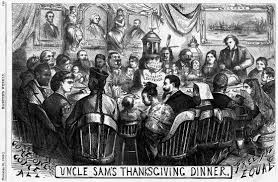
A Miracle, Thanksgiving-type
In a 2003 Boston Globe article titled “Giving Thanks for the Invisible Hand,” syndicated columnist Jeff Jacoby offered a wonderful tribute to the miracle of the invisible hand that makes affordable turkeys available so efficiently every year at Thanksgiving through the power of “spontaneous order” and without the need for any central planning or “turkey czars.”
“The invisible hand” — the mysterious power that leads innumerable people, each working for his own gain, to promote ends that benefit many.”
The Thanksgiving Miracle
Isn’t there something wondrous — something almost inexplicable — in the way your Thanksgiving weekend is made possible by the skill and labor of vast numbers of total strangers?
“The invisible hand” — the mysterious power that leads innumerable people, each working for his own gain, to promote ends that benefit many.”
The Thanksgiving Miracle
Isn’t there something wondrous — something almost inexplicable — in the way your Thanksgiving weekend is made possible by the skill and labor of vast numbers of total strangers?
To bring that turkey to the dining room table required the efforts of thousands of people — the poultry farmers who raised the birds, of course, but also the feed distributors who supplied their nourishment and the truckers who brought it to the farm, not to mention the architect who designed the hatchery, the workmen who built it, and the technicians who keep it running. The bird had to be slaughtered and defeathered and inspected and transported and unloaded and wrapped and priced and displayed. The people who accomplished those tasks were supported in turn by armies of other people accomplishing other tasks — from refining the gasoline that fueled the trucks to manufacturing the plastic in which the meat was packaged.
The activities of countless far-flung men and women over the course of many months had to be intricately choreographed and precisely timed, so that when you showed up to buy a fresh Thanksgiving turkey, there would be one — or more likely, a few dozen — waiting. The level of coordination that was required to pull it off is mind-boggling. But what is even more mind-boggling is this: No one coordinated it.
No turkey czar sat in a command post somewhere, consulting a master plan and issuing orders. No one forced people to cooperate for your benefit. And yet they did cooperate. When you arrived at the supermarket, your turkey was there. You didn’t have to do anything but show up to buy it. If that isn’t a miracle, what should we call it?
Adam Smith called it “the invisible hand” — the mysterious power that leads innumerable people, each working for his own gain, to promote ends that benefit many. Out of the seeming chaos of millions of uncoordinated private transactions emerges the spontaneous order of the market. Free human beings freely interact, and the result is an array of goods and services more immense than the human mind can comprehend. No dictator, no bureaucracy, no supercomputer plans it in advance. Indeed, the more an economy is planned, the more it is plagued by shortages, dislocation, and failure.
It is commonplace to speak of seeing God’s signature in the intricacy of a spider’s web or the animation of a beehive. But they pale in comparison to the kaleidoscopic energy and productivity of the free market. If it is a blessing from Heaven when seeds are transformed into grain, how much more of a blessing is it when our private, voluntary exchanges are transformed – without our ever intending it – into prosperity, innovation, and growth?