Friday, October 10, 2014

Meltdown

September 18th 2008:
550 billion dollars were withdrawn from money market accounts on September 18, 2008 in less than two hours. Panic began to seep into the market and others withdrew money. The FED could not stop it with an infusion of 105 billion so they shut down the money market accounts and guaranteed $250,000 coverage for every money market account. If they had not done that their estimation was that by two o’clock that afternoon, $5.5 trillion would have been drawn out of the money market system of the United States. Panic would have increased, threatened Europe and economic failure was in the offing.
Rep. Paul Kanjorski later described this as an "electronic run on the banks".
https://www.youtube.com/watch?v=ODBPlD0FXOU
Now you can not just take money out of a system anonymously. So who was doing it? There must be a record. But this did not seem to be very interesting to anyone. It likely was a reaction to the Lehman collapse and the money was probably not withdrawn but shifted. (I hope not into short accounts, though.) But it would be interesting to see who it was.That, however, is not--or at least should not-- be the point. Kanjorski is implying the system was "attacked." But that subversive motive actually underestimates the problem. The real problem is that malice was not necessary; the system with its high volume computer trading can do this on its own.
 

Thursday, October 9, 2014

Wednesday, October 8, 2014

Cab Thoughts

The turkey was fed and sheltered for 1000 consecutive days, but this did not mean that the butcher loved him. --anon
 
 
Nearly 85 percent of the population of Qatar is made up of foreigners.
 
A Kurdish official said that Jordan Matson, an American citizen, had joined the Kurdish People's Protection Units (YPG), who are mainly battling advances by Islamic State close to Syria's borders with Turkey and Iraq. A friend of Matson's said he told online gaming friends about two months ago that he was joining a "private army" to fight Islamic State. Matson had said he was formerly in the military.
 
Who is.....Kim Philby?
 
Ignaz Semmelweiss (1818-1865) was a Hungarian physician who used a rigorous analytic approach to determine why women were dying from infection following childbirth. He concluded that there was a connection between the illness and hygiene--of the physician--and recommended vigorous hand-washing between patient contacts. (This was not ever done at the time.) He was committed to an insane asylum when he started to exhibit what was possibly the early onset of Alzheimer’s disease. While there he was beaten by the staff and died from his injuries. One of the most important men of the 19th Century science world was beaten to death in a hospital by its staff.
 
An article, "How Climate Change Helped ISIS," was published in September in the Huffington Post.
 
An editorial writer for the Boston Globe with the wonderful name of Hiawatha Bray has written an article on the importance of addresses when evaluating epidemics. It is a clever idea being pursued by a number of people and countries particularly India, Ireland and the West African countries. Michael Olsen, a Utah land developer has a plan to put millions of people on the map, in Liberia and around the world. Olsen’s nonprofit organization, Addressing Homes LLC, has developed a universal standard for generating addresses, based on a building’s latitude and longitude. He uses Google. There is a funny moment where Olson goes to the Postmaster of Liberia, Frederick Norkeh, and shows him his plan and results.  “I want to take it home and show my wife and family we have an address,” Norkeh said.
 
 
Abigail Adams was determined to save her children from the fate of her brother and his family. (She had seen him succumb to alcohol and debauchery, desert his family, and leave them penniless.) She was very strict with her children. She actually took her seven year old son John Quincy to Bunker Hill on June 17, 1775 to see the price paid for freedom. Amid the carnage he saw the Adams' family friend, Dr. Joseph Warren, killed.


The vineyard canary: Vintners plant roses among their vines because they get sick before anything else in the field. If there’s mildew in the air, it will infect the roses first and give a winemaker a heads-up that it’s time to spray.


Wainwright, a pitcher with consummate control, hit the Dodgers Puig with a ninety-mile-an-hour fastball. The next man up, Gonzalez, initiated an almost fight with this exchange with the Cardinal catcher Molina:

"I was just basically saying, 'You guys keep doing this over and over. We're not going to put up with that,'" Gonzalez said after the game. "They're going to say it's not on purpose, but come on. It's Wainwright. He knows where the ball is going." Gonzalez said Molina's response was, "You've got to respect me."
"I thought that was out of context, but it's what he said," the Dodgers first baseman said.
 
On Sept. 25, 2013, the Washington Post reported that Antarctic sea ice had grown to a record extent for the second straight year — some 19.51 million square kilometers. In June of this year, the Post noted a possible new record ice extent is "part of a puzzling 33-year trend in increasing sea ice around Antarctica."
 
"But even in the United States, human slavery now is greater than it ever was during the 18th or 19th century. In Atlanta, Georgia, we have between 200-300 girls sold into sexual slavery every month." So former President Jimmy Carter said in an interview. The fantasy world of politicians always substitutes hyperbole as fact. Like art, it becomes a reflection of reality and of value itself.
 
The National Book Foundation named the authors included on this year's "5 under 35" list. The young authors are occasional NPR contributor Alex Gilvarry, Yelena Akhtiorskaya, Valeria Luiselli, Kirstin Valdez Quade and Iraq War veteran Phil Klay, whose short story collection Redeployment also made it onto this year's longlist for the National Book Awards.
 
In 1940, the Japanese Army Air Force bombed Ningbo with ceramic bombs full of fleas carrying the bubonic plague. Many of these operations were ineffective due to inefficient delivery systems, although up to 400,000 people may have died. During the Zhejiang-Jiangxi Campaign in 1942, around 1,700 Japanese troops died out of a total 10,000 Japanese soldiers who fell ill with disease when their own biological weapons attack rebounded on their own forces.
 
In the South China Sea there are four narrow  "choke points," the Malacca, Sunda, Lombok, and Makassar straits. More than half of the world's annual merchant fleet tonnage passes through these choke points, and a third of all maritime traffic worldwide. The oil transported through the Malacca Strait from the Indian Ocean, en route to East Asia through the South China Sea, is triple the amount that passes through the Suez Canal and fifteen times the amount that transits the Panama Canal. 200 small islands and rock/reefs lie in this area and, although most are rarely above water, these sites are lusted after by local nations--including China--because of their geographical importance but also for their possible oil reserves.


Factitious \fak-TISH-uhs\, adjective: 1. Produced artificially, in distinction from what is produced by nature. 2. Artificial; not authentic or genuine; sham. From Latin facticius, "made by art, artificial," from the past participle of facere, "to make."


The huge cyberattack on JPMorgan Chase that touched more than 83 million households and businesses was one of the most serious computer intrusions into an American corporation. Also troubling is that about nine other financial institutions — a number that has not been previously reported — were also infiltrated by the same group of overseas hackers, according to people briefed on the matter. The hackers are thought to be operating from Russia and appear to have at least loose connections with officials of the Russian government, the people briefed on the matter said. (NYT)


AAAAaaaannnnnnddddd......a poem that NPR called "devastating:"
 
Certain moments send adrenaline to the heart, dry out
the tongue, and clog the lungs. Like thunder they drown
you in sound, no, like lightning they strike you across the
larynx. Cough. After it happened I was at a loss for words.
Haven’t you said this yourself? Haven’t you said this to a
close friend who early in your friendship, when distracted,
would call you by the name of her black housekeeper?
You assumed you two were the only black people in her
life. Eventually she stopped doing this, though she never
acknowledged her slippage. And you never called her on
it (why not?) and yet, you don’t forget. If this were a
domestic tragedy, and it might well be, this would be your
fatal flaw - your memory, vessel of your feelings. Do you
feel hurt because it’s the ‘all black people look the same’
moment, or because you are being confused with another
after being so close to this other?
 
An unsettled feeling keeps the body front and center. The
wrong words enter your day like a bad egg in your mouth
and puke runs down your blouse, a dampness drawing
your stomach in toward your rib cage. When you look
around only you remain. Your own disgust at what you
smell, what you feel, doesn’t bring you to your feet, not
right away, because gathering energy has become its own
task, needing its own argument. You are reminded of a
conversation you had recently, comparing the merits of
sentences constructed implicitly with ‘yes, and’ rather
than ‘yes, but.’ You and your friend decided that ‘yes,
and’ attested to a life with no turn-off, no alternative
routes: you pull yourself to standing, soon enough the
blouse is rinsed, it’s another week, the blouse is beneath
your sweater, against your skin, and you smell good.
 
The rain this morning pours from the gutters and everywhere
else it is lost in the trees. You need your glasses
to single out what you know is there because doubt is
inexorable; you put on your glasses. The trees, their bark,
their leaves, even the dead ones, are more vibrant wet.
Yes, and it’s raining. Each moment is like this - before
it can be known, categorized as similar to another thing
and dismissed, it has to be experienced, it has to be seen.
What did he just say? Did she really just say that? Did I
hear what I think I heard? Did that just come out of my
mouth, his mouth, your mouth? The moment stinks. Still
you want to stop looking at the trees. You want to walk out
and stand among them. And as light as the rain seems, it
still rains down on you.
--Claudia Rankine,  a chancellor of the Academy of American Poets and the 2014 winner of the Jackson Poetry Prize. She teaches at Pomona College.

Tuesday, October 7, 2014

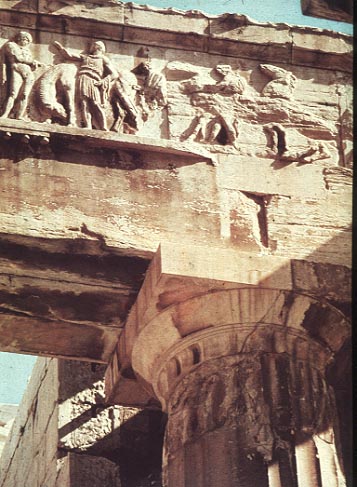
Parthenon Frieze


The Parthenon in Athens is crowned with a frieze depicting ancient conflicts as well as a procession with its horses and horsemen, youths and elders, men and women, and animals. This procession is said to be the Great Panathenaia which occurred, like the Olympics, every four years; it was a festival of athletic games and poetry and music competitions culminating at the temple of Athena, goddess of weaving, war, and wisdom where her statue was then presented with a new peplos, a robe woven by the women of Athens. There are no ancient explanations for this frieze; the Great Panathenaia suggestion was made by Englishmen James Stuart (an artist) and Nicholas Revett (an amateur architect) in the late 1700s. Interestingly, should this be a depiction of contemporary 5th Century Greece, it would be rare; Greek temple art usually shows history and myth. The rest of the sculptures on the Parthenon, the pediments and metopes, depict myths from Athens’s founding and prehistory, from the contest between Athena and Poseidon for the city’s patronage to the battle of the Lapiths against the Centaurs. The Great Panathenaia, a contemporary topic for the time, would be a most unusual artistic subject.

Enter Joan Breton Connelly, an American classical archaeologist and Professor of Classics and Art History at New York University. In her book, "The Parthenon Enigma," she  offers a completely different and provocative version of the frieze.

She focuses on the unusual story of Erechtheus, an early Athenian king, King Erechtheus. An ancient story, he was written about by Herodotus and in a lost play by Euripides. Herodotus states that Erechtheus and Athena were worshiped jointly in Athens; he is the king commemorated in the Erechtheion, the small, exquisite temple that sits opposite the Parthenon on the north side of the Acropolis, distinguished by its famous portico of caryatid maidens. New passages of Euripides’ lost play on the subject have been discovered in wrappings from a third-century B.C. Egyptian mummy. Euripides’ play had long been known only from quotations of other ancient authors but this find doubled the numbered of recovered lines from the lost play.
The myth is basically this: King Erechtheus sprang directly from the Attic earth. He had a wife, Praxithea, and three daughters. (The Athenian royal houses ran to daughters.) When Eumolpus, king of nearby Eleusis, threatened a siege of the city, King Erechtheus received a terrible message from oracle at Delphi: He must sacrifice one of his daughters to Athena to save the city. The queen, rather than cringing in horror at the idea, embraced it as patriotic duty. (Praxithea, whose name means “she who acts for the goddess,” delivers a rousing speech in the Euripides play.) Meanwhile, the three girls have vowed that if one dies, they all will—so the two who are not chosen insist either on being sacrificed as well or on killing themselves, possibly by jumping from the Acropolis. Athena then declares that the heroic girls are to be buried in a single tomb and that there should be a sanctuary and sacred rites established in their honor. Erechtheus, who dies in the battle, will have a tomb on the Acropolis and a sacred precinct. Athena makes Queen Praxithea her priestess, and Praxithea will be in charge of a single altar to serve both shrines. 
Connelly connects the frieze as a visual memento of the invisible past—the trauma of the Persian invasion, for instance—and the centrality of the Erechtheus myth to Athens’s sense of itself, the willingness in a democracy to give one life for the good of the many, and for even the city’s leadership to make the supreme sacrifice.

(from an article by A.E. Stallings)

Monday, October 6, 2014

Stats vs. Prejudice

A fireballing righthanded relief pitcher is brought in to the game in the bottom of the ninth. There are two outs with the tying run at third and the winning run at second. First is open. Next up in the third position is a weak hitting shortstop brought in for defensive purposes earlier currently hitting .220 with one home run and six rbis. On deck is the opponent's power hitter, a left hander with 30 home-runs and 70 RBIs, hitting .290. The question--that the relief pitcher probably never asks--is would both these encounters, the relief pitcher vs. the shortstop or the number four hitter, be the same. Would the pitcher do just as well pitching to the number four hitter?
The answer, of course, is no. The reason is that, while God has created all humans with equal love and spiritual value, in some social situations there are hierarchies.
This is not to diminish shortstops but, sometimes, they just can't hit.

Sunday, October 5, 2014

Sunday Sermon 10/5/14

The 77-year-old pontiff gave an interview to Il Messaggero, Rome's local newspaper, to mark the feast of Saints Peter and Paul, a Roman holiday.
He was asked about a blog post in the Economist magazine that said he sounded like a Leninist when he criticized capitalism and called for radical economic reform.
"I can only say that the communists have stolen our flag. The flag of the poor is Christian. Poverty is at the center of the Gospel," he said, citing Biblical passages about the need to help the poor, the sick and the needy.
"Communists say that all this is communism. Sure, twenty centuries later. So when they speak, one can say to them: 'but then you are Christian'," he said, laughing.

Saturday, October 4, 2014

Cab Thought 10/4/14

"There is only one difference between a bad economist and a good one: the bad economist confines himself to the visible effect; the good economist takes into account both the effect that can be seen and those effects that must be foreseen. "Yet this difference is tremendous; for it almost always happens that when the immediate consequence is favorable, the later consequences are disastrous, and vice versa. Whence it follows that the bad economist pursues a small present good that will be followed by a great evil to come, while the good economist pursues a great good to come, at the risk of a small present evil."  - From an essay by Frédéric Bastiat in 1850, "That Which Is Seen and That Which Is Unseen"

Thomas Eric Duncan appeared at Texas Health Presbyterian Hospital on September 26th, complaining of fever and abdominal pain. He had just come from West Africa. He was sent home where he incubated with his Ebola for two more days before returning to the hospital. One can only wonder if our vigilant health care system is cut from the same cloth as our vigilant Secret Service system. Put another way, are we on our own out here?

Columbia, in 1992, led the world in intentional homicides (93 per 100,000 people). The mayor of the town of Cali, a physician, looked at the problem as an epidemic and investigated it as an infection. He found nearly two-thirds of the homicides took place on weekends, usually after payday. More than half of the cases involved alcohol or happened at bars.
 
Truck driver is the number-one occupation for men in the U.S..

By measuring trace radioactive carbon in the wine, most bottles can be dated to within a year or two of the vintage.

ABC News reporter Jonathan Karl questioned President Obama’s comments during a CBS 60 Minutes interview explaining that the intelligence community had “underestimated” the strength of ISIS in Syria. “I think our head of the intelligence community, Jim Clapper, has acknowledged that I think they underestimated what had been taking place in Syria,” Obama said.
Karl then cited Former Director of the Defense Intelligence Agency Lt. Gen. Michael Flynn who warned that ISIL “probably will attempt to take territory in Iraq and Syria to exhibit its strength in 2014.”
Oh, well.
Wait. Weren't the intel reports the reason we originally invaded Iraq in the first place?
Oh, well.
 
 More than a hundred and ninety million children under the age of five suffer from vitamin-A deficiency. Every year, as many as half a million will go blind.

According to TheDrinksBusiness.com, the world's smallest vineyard is located in Les Amis de Farinet in Switzerland’s Valais region, and consists of just three vines. Who owns it? The Dalai Lama!

What was.....Lake Peigneur disaster?

Will automation increase unemployment? Historically the answer is "no." And one should always be cautious when one hears "This time it is different." One theory is that the concentration of automated workplace cannot survive without a buyer of the automated produced products so that the expansion of automation is inherently self-limited. Another is that the megalith of automation will result in increased, small individualism with an emphasis on uniquely human jobs and projects.
One question worth remembering: Who will be better off, the culture that resists automation or the one that adapts?

A guy named Sir Young, who was convicted of rape in Texas, was ordered to serve 250 hours of community service at a rape crisis center. Read that again, if you must.

Helpmate: from helpmeet. The existence of the synonyms helpmeet and helpmate is the result of an error compounded. God's promise to Adam in Genesis 2:18, as rendered in the King James version of the Bible (1611), was to give him "an help [helper] meet [fit or suitable] for him." The poet John Dryden's 1673 use of the phrase "help-meet for man," with a hyphen between help and meet, was one step on the way toward the establishment of the phrase "help meet" as an independent word. Another was the use of "help meet" without "for man" to mean a suitable helper, usually a spouse, as Eve had been to Adam. Despite such usages, helpmeet was not usually thought of as a word in its own right until the 19th century. Nonetheless, the phrase "help meet" probably played a role in the creation of helpmate, from help and mate, first recorded in 1715. (from the on-line dictionary)
 
The meaning of peace is the absence of opposition to socialism. So said Karl Marx. A little Koran-like, don't you think?

Russia’s state-run OAO Rosneft
said a well drilled in the Kara Sea region of the Arctic Ocean with Exxon struck oil, showing the region has the potential to become one of the world’s most important crude-producing areas. I hate it when the good guys help the bad guys.

What ever happened to Penn State and the Clery Act?

Apparently there will be some debate over the legacy of Eric Holder at Justice. This goes to show how wonderfully diverse our community thinking has become. People looking at Holder's tenure can actually come to different conclusions. 
As a deputy attorney general in 1999, he recommended pardons for 14 Puerto Rican terrorists. A year later, he did the same for fugitive financier Marc Rich. Marc Rich! He then, as AG, created the Fast and Furious program that provided weapons for drug cartels for some still unexplained reason, ignored the IRS abuse and political targeting, developed a program for dealing with illegal immigrants that can only be called a non-program, became the first AG in the history of the nation to be held in criminal contempt of Congress and somehow, aided and abetted by the President of the United States, turned race into the prime focus of the country's legal system. The debate should not be over the quality of his leadership but rather whether or not the disasters he created were criminal or just stupid.
 
Golden oldie:
http://steeleydock.blogspot.com/2013/05/the-fox-applies-for-henhouse-job-and-he.html

Mike Tomlin was interviewed by Fox News lady Laura Okmin and he said this in response to her question as to whether or not he was a "player's coach:"  "It means something about my age or my race." Later on, "It's somewhat insulting." Probably wants to be AG.
 
Airstrikes against ISIS militants are a "psychological operation," not a military one, Iranian President Hassan Rouhani told CNN's Christiane Amanpour in an interview . I hate it when the crazies sound sensible.

A controversial immigration program in the U.S. called Deferred Action for Childhood Arrivals, or DACA, allows temporary relief from deportation. Since the Obama administration created the program in 2012, more than 580,000 unauthorized immigrants brought to the U.S. as minors have qualified for DACA and been given work permits that last for at least two years. Mexican consulates around the U.S. have been paying fees for some DACA applicants through a little-known program for Mexican citizens with financial need.
There is a decades-long migration trend that led to 9 percent of people born in Mexico now live in the United States.
 
The 700-year-old tomb of Suleyman Shah, grandfather of the founder of the Ottoman Empire, is in a Turkish enclave in northern Syria  guarded by several dozen Turkish soldiers and perched on a manicured lawn under a Turkish flag on the banks of the Euphrates. The tomb was made Turkish territory under a treaty signed with France in 1921, when France ruled Syria. Islamic State and other Islamist groups, whose strict Salafi interpretation of Islam deems the veneration of tombs to be idolatrous, have destroyed several tombs and mosques in Syria. Ankara regards it as sovereign territory and has repeatedly made clear that it will defend the mausoleum if it is attacked. So Turkey's position with the homicidal maniacs might hinge on their ancient tomb, their disregard for the dead apparently being more important than their disregard for the living.
 
AAAAAaaaaaaannnnnndddd.....a graph:
Chart of the Day