Monday, June 5, 2017

Pruitt

Administrator of the Environmental Protection Agency, Scott Pruitt, was interviewed about Trump's decision on the Paris Accords. These are some excerpts:


Re: legal vulnerability (the Americans being vulnerable to domestic climate activists was a question I had not considered):
You know, that this idea that somehow that it was just simply not enforceable, or not something that really could be enforced domestically, and that’s just simply not the case. I mean, when you look at our Clean Air Act, China and India don’t face what we do domestically. What we face domestically was you know, with the Paris Agreement in place, are 26-28% targets with all of the previous actions by the previous administration, the climate action agenda, the Clean Power Plan and the rest, still fell 40% short of those 26-28% targets. And so we were vulnerable to an action by an environmental group here domestically to sue under the Clean Air Act, specifically Section 115 of the Clean Air Act, to compel regulatory response. I mean, this was a legal evaluation as much as anything to make sure that our agenda wouldn’t be hijacked or dominated by some sort of litigation post-staying in Paris. So this was a very important decision across the board. But part of the decision, in fact, a major part of the decision was the legal vulnerabilities.


Re: the process of ratification (I do not think the Europeans understand this):
We know that the individuals of Paris negotiating for the United States and also those in attendance on behalf of other countries, walked up to the very line. They did all that they could to create what would be constituted a treaty, but then called it something else. And they did that, because they knew they couldn’t get it ratified in the U.S. Senate. And that’s just a bad way to do business. I mean, when you have decisions being made in Paris that impact the cost of electricity in this country, or a contraction of the power grid, or you’re taking fossil fuels, natural gas or coal off the power grid, those types of things, voters ought to have a voice in that process, and that’s what the U.S. Senate and Constitutional protections are intended to address.


On the income shifts:
....if every nation that signed up for Paris met all of the commitments that they put as part of that agreement, by the year 2100, the temperature would be reduced all of two-tenths of one degree Celsius. And for what cost,....? I mean, in this country, it was a $2.5 trillion dollar cost for gross domestic product. I mean, this was a bad business deal both on advancing environmental objectives, but also the cost that it took domestically while the rest of the world skated. China and India took no steps to meet their obligations until 2030. In fact, India qualified any steps on receiving $2.5 trillion dollars of aid through the Green Climate Fund.......why wouldn’t you want the United States in this deal if you’re the rest of the world? I mean, one, you’re extracting billions of dollars in aid. India is taking no steps. I mean, we’re subsidizing their manufacturing base. And they’re taking no steps to reduce their CO2 emissions. I mean, under the deal, China is continuing to build coal generation facilities, and 365 or so, I can’t remember the exact number, but and I think 800 plants. You know, under the deal, Russia came in and said yes, we’ll agree to target reductions, but we’re going to use a baseline of 1990. And so they had like 20-plus percent reductions, but they baseline it in 1990. Our baseline was 2006, which is, I think, after all some of the progress we had made with respect to reducing CO2 emissions. So it was a much greater hit on our economy versus Russia, and obviously China and India. And this was a bad deal for this country.


On his own position:
The climate is changing. The climate has warmed. Human activity contributes to it. How much human activity has contributed to it is difficult to measure with precision. But we have processes that have to be followed. We have innovation technology that can achieve good outcomes in CO2 reduction. You know, there’s a term that I’ve been using here of late. You know, they like to throw out climate denier and those types of things, which I don’t even understand what that means, honestly. But there are climate exaggerators in the marketplace. And there are people that take data that we know, and they stretch it so far that it becomes incredible, and people don’t believe it....[in]....   the New York Times paper, about a month ago... [t]here was an op-ed called Climate of Complete Certainty where the person writing the op-ed said exactly that, that the politicians have taken scientific data and stretched it so far that the American people don’t have confidence or trust that they can rely upon the information. So what we need is truth.

Sunday, June 4, 2017

Pentacost

 There is a bird in the church today, a big one, with a loud and varied song. On Pentecost one might get symbolic here but its probably just a bird of pray.

Today is Pentecost, observed 7 weeks after Easter. It is a complex day in the Church in history and meaning.
Literally Pentacost means "fifty," as the fiftieth week of the year. It, in the Old Testament, refers to the giving of the Ten Commandments and, in the New testament, signifies its new direction. Christ reappears to the fearful apostles, reinvigorates them and then breaths upon them, infusing the spirit of the New Testament and the abilities to carry out their evangelism. "Whose sins you forgive..." essentially creates a church structure.
 In England it is--or was--the feast of Whitsun, so changed after the Norman Conquest. Whitsun is a contraction of "White Sunday," attributed to the white vestments worn by catechumens on the day. Eventually white (hwitte) began to be confused with wit or understanding, not entirely inappropriate for the occasion. It was a significant holiday and celebration in its time and began to substitute for more secular spring celebrations.

The word for "Spirit" in Greek has several meanings; it also can mean "wind" and "breath." Christ does breath on the apostles and the Spirit is often described as a great wind. One ancient writer describes the Holy Spirit as Christ's last expired breath on the cross.

Breath is, of course, different from wind, which can be destructive, even in the scorching Middle East. But Christ's breath is gentle; it seems there is no downside here, no risk. Unless to the recipient who internalizes it. Of the apostles--who all abandoned Christ to die alone--after Pentecost, all, save John, died for Christ's message.
In our cautious and uncertain world, Pentecost might be more safely observed from a window.


Sunday/Pugh

In "Chocolate from the Famine Museum," the poet Sheenagh Pugh writes about a guide's earnest efforts to make the history of The Great Hunger alive and relevant to comfortable and privileged children. It caught my eye because my family is from Roscommon.


Chocolate from the Famine Museum
Strokestown, Co Roscommon
Reading numbers on a wall,
so many thousand evicted,
exiled, starved,


soon palls. The boys are looking
for buttons to press,
and Sir’s at a loss


how to bring it alive. He tries
to give them the reek
of peat smoke and lamp oil


in a cramped turf cabin,
wishing there was a replica
they could crowd into.


At every turn, language
fails him. Starving
means wanting dinner,


not boiling boot-leather
till you can chew it,
hoping it stays down.


They sailed to America,
he laments, to lads
who’ve flown there


on holiday, who make nothing
of oceans. They fidget
through the video,


dying for their reward:
the gift shop.
Their faces light up,


for the first time, at sheep
in green hats, penny whistles,
toy blackthorn sticks,


and the chocolate. Praline,
ganache, mint, mocha, truffle,
they’re spoiled for choice,


their day flavoured
for ever with the velvet
dark in their mouths.


SHEENAGH PUGH (2003)

Saturday, June 3, 2017

Accord2

Sandra has noted, critically, that I have not condemned Trump's exit from the Paris Accords. What is interesting about the Accords is why some people are so passionate about them. The basic American objection--and mine--is that it is a treaty Obama structured to enact by dodging the constitutional requirements for treaties. I think that wrong. The motives--arrogance, elitism, vision of higher good--are interesting and instructive but not as important to me as preserving the country's foundational laws. So I oppose the effort to side-step the basic, clear rules that make the democracy up. 

Foreigners in European capitals may have no real interest--or knowledge--of that objection but, if they will excuse me, this is my country. Our rules are important to me. 

They may be entirely concerned with the practical problems of global warming and willing to do anything to improve matters. Accepting that as their motive, what do the Accords actually do? The most complimentary assessment I have read is that it brought nations together for a common and important cause. The effectiveness of that effort is not in question. But it should be.
The debate over global warming centers on several elements. The earth seems to be warming, how do we measure that, what are the factors and how can we, if possible, influence the process?

Current political belief is that the climate is changing, not through regular and natural processes but rather as the side effect of  human activity, particularly as the result of carbon fuel use. The data has been argued over but computer models have been developed to predict the future effect and they are dire. The problem is that many do not think the data accurate and, more import, the models using that data to predict future activity have not been correct. That raises questions--reasonable questions--as to the accuracy of the original data and/or the models based upon them. 

The second objection is the Procrustean distortions the Accords go through to accommodate the various signers. Nations are to assess themselves on their progress, progress which is very different for each nation, and culturally based. So China continues to build coal-fire plants at the rate on one a week. Nor is there any enforcement program. Nor is their a mechanism approved for the nations to use; that is said to be coming.

One definite position is that carbon as an energy source will have to go, certainly in the next generation and a half. All of the power of transportation, temperature and information will have to come from a new source, a source we do not have or use. An entirely new power source for humanity will have to be invented, developed and put into service to replace the abundant and cheap carbon power we use now. If one is worried about disorder, imagine the effect of turning off the world's industrial carbon power switch without an adequate, affordable replacement.

And this effort will have to be financed, financed by someone.

This may look like a good plan to Europe but, constitutional objections aside, it looks like a lousy idea to me. It doesn't look like an idea at all; it looks like a wish. And, somehow, my bet is that we, more than anyone, will be financially responsible for this long term project.
Actually, this looks like a placebo, therapy whose benefit depends upon the optimism of the participants. And an unending series of proclamations, good ideas, unasked for leadership, interventions and great dinners for the participant ruling class that will go on and on as a make-work project for the rich forever.

Reverie

“The press takes him literally, but not seriously; his supporters take him seriously, but not literally.”--Salena Zito 


Markets require that one consider the point of view of others and alter one’s behavior to satisfy their desires.  This disposition supports three liberal virtues.  The first is deliberation, the ability to consider an opposing viewpoint.  The other two virtues are negative.  Markets weaken loyalty to tribe and family, cultivating the ability to relate to strangers according to impersonal criteria.  Finally, markets break down aristocratic habits, encouraging people to relate peaceably as equals. --Nathan Oman


".... people "have taken an expectation that previously applied to the private sphere — control over our environment — and are increasingly applying it to the public sphere." Social media's "self-affirming feedback loop" encourages "expectations for a custom-made reality" and indignation about anything "that deviates from our preferences." The consequences of what Stewart calls "our growing intolerance of an unedited reality" are enumerated in Tom Nichols' new book "The Death of Expertise: The Campaign Against Established Knowledge and Why It Matters." Our devices and social media are, he says, producing people who confuse "internet grazing" with research and this faux research with higher education..." (Will)


Say you have a study that shows a drug significantly improves the life expectancy of someone with a particular illness. Is it ethical to try to reproduce the results of the study?

Who is....Patrick Frank?


Since 2010, when the government took over student lending, direct government lending to students has gone from approximately $200 billion to more than $900 billion—creating dramatically increased student defaults and a population that is rightfully angry about how much money they owe, particularly since it reduces their ability to get other credit. (from Jamie Dimon's letter to shareholders)


"In horrible madness Caligula wished that the entire Roman people had one head so that he could strike it off. The civilization of the twentieth century has made it possible for the raving madness of the modern imperialists to realize similar bloody dreams. By pressing a button one can expose thousands to destruction. It was the fate of civilization that it was unable to keep the external means that it had created out of the hands of those who had remained estranged from its spirit. Modern tyrants have things much easier than their predecessors. "


This is von Mises musing on the first great war with the ability of the nations to kill and the inability of the citizen to hide.


According to the NYT, current academic definitions include the following changes: "sex is never truly consensual between adults unless they both have equal power." You may mull that over.


The U.S. military was the world's 17th largest in April 1917, smaller (less than 250,000) than Romania's, and smaller than Britain's casualties in one battle. America's military became a melting pot for a nation in which one-third of the population had been born abroad or whose parents had been. Forty-three languages were spoken in one Army division raised in New York. (Will)

That "melting pot" unleashed a flu pandemic that killed more people in a year — somewhere between 20 million and 50 million — than the war killed in four years.


Toshiba--Toshiba!--expressed doubt for the first time over whether it can continue as a going concern, citing huge losses at its U.S. nuclear subsidiary which filed for bankruptcy last month.


Golden oldie:

http://steeleydock.blogspot.com/2016/02/the-second-commandment.html


steeleydock.blogspot.com
You shall not make for yourself a graven image, or any likeness of anything that is in heaven above, or that is in the earth beneath, or...


steeleydock.blogspot.com
You shall not make for yourself a graven image, or any likeness of anything that is in heaven above, or that is in the earth beneath, or...


The writer Deborah Levy was asked which she preferred, modernist or post-modernist and she replied, "Modernism. Post is like having a conversation with someone who never looks at you."


Which is more simplistic, "Let the market with its millions and millions of self-interested participants handle it" or "Let the government handle it?"


The reason elite values have been enshrined as ‘the truth’, right from the Ancient Greeks onwards, is because the rulers of society need to secure the deference of the masses. The masses are being encouraged to defer not to the power of the elites, but to the truth of elite values. While each revolt of sections of the public against the values of the elites has been met with the riposte that people are no longer interested in the truth, what the elites really mean is that people don’t care about their version of the truth. So when the French celebrity philosopher Bernard-Henri Levy asserted that people have ‘lost interest in whether politicians tell the truth’, he was venting his frustration at an electorate that no longer shares his values. A recent essay by suggests the era of deference toward elite values may be over.


Mrs. Clinton, who was Sec. of State during the infamous "Red Line" speech by Obama, had the gall to urge military action against Syria recently..


Measurement errors: Patrick Frank is a scientist at the Stanford Synchrotron Radiation Lightsource (SSRL), part of the SLAC National Accelerator Laboratory at Stanford University. Frank has published papers that explain how the errors in temperatures recorded by weather stations have been incorrectly handled. Temperature readings, he finds, have errors over twice as large as generally recognized. Based on this, Frank stated, in a 2011 article in Energy & Environment, “…the 1856–2004 global surface air temperature anomaly with its 95% confidence interval is 0.8˚C ± 0.98˚C.” The error bars are wider than the measured increase. It looks as if there’s an upward temperature trend, but we can’t tell definitively. We cannot reject the hypothesis that the world’s temperature has not changed at all.

Sometimes people are just not able to process and explain and overt idiocy should disqualify them from doing so.
A Syria theory on the Right: The U.S. government actually carried out the chemical weapons massacre in Syria last week — a "false flag" to trick President Trump into retaliating, thus entangling himself in a foreign war. A slightly more convoluted Syria theory on the Left: Russian President Vladimir Putin ordered the chemical weapons massacre to help Trump — distracting Americans from an investigation into Trump's campaign ties to Russia by provoking the missile strike.
That theory — evidence-free — was laid out on a small anti-Trump site shortly after the missile strike.
But it went mainstream Friday night, when Lawrence O'Donnell advanced similar speculation on his MSNBC show, "The Last Word."  
How can anyone be asked to take these people seriously?


Tesla’s market cap surpassed that of Ford. But Ford sells a lot more cars than Tesla. When the cost of capital is zero or less, many unreasonable things are possible.

Bogel recently said this: "Find a company that is the right company, even if it is the wrong job for you. Once you get in the door, it will be a much wider opportunity,"


At least two-thirds of federal spending can be described as Congress’ taking the rightful property of one American and giving it to another American, to whom it does not belong.  So-called mandatory spending totaled $2.45 trillion in 2015.  Thus, two-thirds of the federal budget goes toward Medicaid, Medicare, Social Security, food assistance, unemployment and other programs and benefits that fall into the category of taking from some and giving to others. (Williams)


"Certainly misogyny played a role, I mean that just has to be admitted," Hilary Clinton said yesterday in discussing her loss to Trump. And she offered a mixed religious/biologic non sequitur: "The things that come out of some of these men's mouths, like why do we have to cover maternity care? Oh I don't know, maybe you were dropped by immaculate conception?" she said.

V-P Pence does not attend one-on-one dinners with women other than his wife Karen, and he does not drink alcohol in social settings when Karen is not with him. This has raised all sorts of strange questions on the Left. Jonah Goldberg's good line: "Elites say we have no right to judge adultery, but we have every right to judge couples who take steps to avoid it."


More on measurement error by Patrick Frank:
Climate models are used to assess the CO2-global warming hypothesis and to quantify the human-caused CO2 “fingerprint.”
How big is the human-caused CO2 fingerprint compared to other uncertainties in our climate model? For tracking energy flows in our model, we use watts per square meter (Wm–2). The sun’s energy that reaches the Earth’s atmosphere provides 342 Wm–2—an average of day and night, poles and equator—keeping it warm enough for us to thrive. The estimated extra energy from excess CO2—the annual anthropogenic greenhouse gas contribution—is far smaller, according to Frank, at 0.036 Wm–2, or 0.01 percent of the sun’s energy. If our estimate of the sun’s energy were off by more than 0.01 percent, that error would swamp the estimated extra energy from excess CO2. And, unfortunately, the sun isn’t the only uncertainty we need to consider.


Freedom means freedom: not necessity, but choice; not responsibility, but the choice between responsibility and irresponsibility; not duty, but the choice between accepting and rejecting duty; not virtue, but the choice between virtue and vice. --Frank Meyer


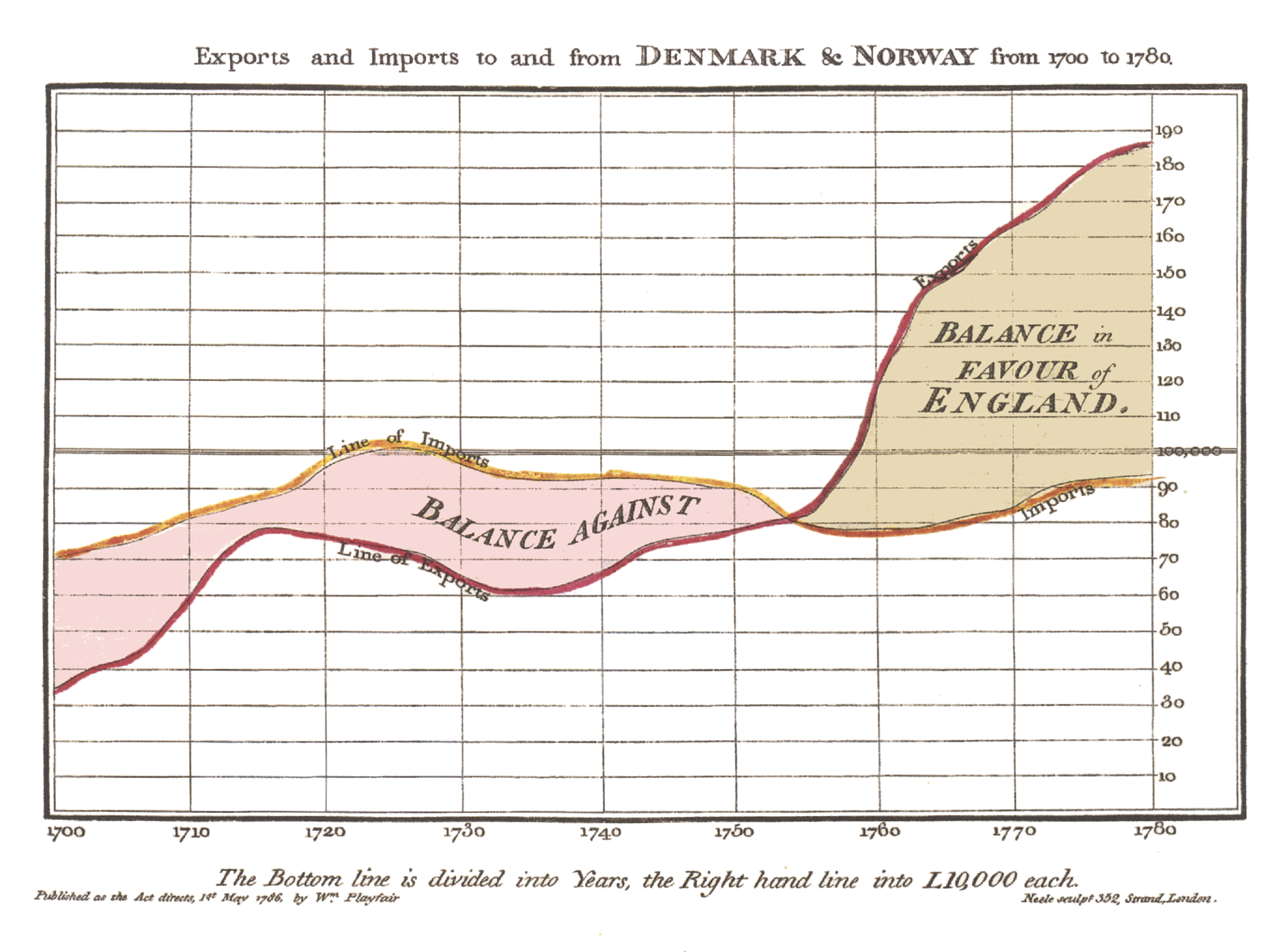
AAAaaaaaannnnnnnnddddddd.....a graph:
It was a Scotsman named William Playfair who invented statistical graphics in the 18th century, during that period when the Scots were building the modern world. Here is a lovely line graph of his from 1786 showing England's trade balance with Norway and Denmark.

Friday, June 2, 2017

Backchannel

A report from the Innuendo Front.

A panel segment on NBC’s “Meet The Press” Sunday morning was discussing reports that White House advisor Jared Kushner may have suggested establishing a communication back channel with Russian officials. Kimberly Strassel of The Wall Street Journal  interjected this information to place the dreaded "back channel" in some perspective:

"Let me set the scene for you: It’s 2008, we are having an election and candidate Obama, he’s not even president elect, sends William Miller over to Iran to establish a backchannel, and let the Iranians know should he win the election they will have friendlier terms. Okay? So this is a private citizen going to foreign soil, obviously in order to evade U.S. intelligence monitoring and establishing a backchannel with a sworn enemy of the United States who was actively disrupting our efforts in the military in the Middle East."

Not to say this is ok, just that it is common--our esteemed leaders see themselves well beyond our mundane restraints-- and criticism of our esteemed leaders is quite selective.

Thursday, June 1, 2017

Accords

The Paris Accords

Trump is said to be considering leaving the Paris Climate Accords. I do not know his reasons but reasons are often foreign to him. The main American objection to the Treaty has been that it was negotiated and signed outside of established Constitutional Law: The Congress, not the Administrative Branch, confirms treaties. The Constitution provides that the president "shall have Power, by and with the Advice and Consent of the Senate, to make Treaties, provided two-thirds of the Senators present concur" (Article II, section 2).
The international reaction to the recent Trump rumor has been quite negative, as if a great and noble thing will be lost if the U.S. indeed leaves.
Here is a summary of several points of the Treaty:

In 2009, in Copenhagen, the world’s nations agreed: The global temperature average should not be allowed to rise more than two degrees Celsius over pre-industrial levels. This is a difficult demand because the very nature of the mechanism and degree of global warming is in dispute. The data has been criticized and the models based upon that data have not been accurate. Nonetheless, in 2015, the Paris climate deal agreed to limit the rise of global temperature to 1.5 degrees Celsius in this century. To bell the cat, the agreement also directed the Intergovernmental Panel on Climate Change—the climate-science arm of the UN—to draw up a report by 2018 on how to reach that 1.5 degrees Celsius target.
 
The mechanisms of this rise is assumed to be carbon fuel. If humanity hopes to keep warming below 1.5 degrees Celsius by 2100, it must essentially stop emitting greenhouse gases into the atmosphere by 2060, according to a recent study from Nature Climate Change. Their estimates come from the same unfulfilled models mentioned above. The Paris meeting could not agree on this crucial concept because the world runs on carbon and replacing it implies relying on technology we do not yet use.

If nations eliminate carbon fuel which is cheap and efficient for another energy source we do not have or use, changes will be necessary. Alternative power sources must be made available. Growing nations will be especially stressed it is said, but it is difficult to imagine how established economic powers like the U.S., China, Russia and India will manage such a conversion. This energy gap is not filled by the Paris Accords but it seems that money will solve the question. As usual, as it is assumed that someone will have to pay and, unsurprisingly, it seems that the Americans are most likely to be the ones. Mrs. Clinton, in Copenhagen, volunteered $100 billion that the rich world would “mobilize." But "mobilize" is different from "pay."  And the Paris agreement includes no new specific commitments to finance the change. But item 115 of the Paris decision says that more than that $100 billion will be needed.

How will the progress of this vision be assessed? The Paris agreement deals with both "stocktaking" and "ratcheting." It announced that the first  taking stock will occur in 2023, then every five years, and that countries should “update and enhance” individual plans at that and future meetings, those innovations presumably the ideas the aforementioned  Intergovernmental Panel on Climate Change will bring forth in 2018.

No outside agency will approve and oversee whether nations are keeping their words—this was a red line for China and India. But under Article 13, nations will be subject to a common framework of transparency, though it will recognize that developing countries may need more help reaching their goal.

According to the U.N.’s website on climate change, the agreement has a “hybrid of legally binding and nonbinding provisions.”
But there’s no clear cut consequence or penalty for countries that fall short of their pledged goals.
 
So we have a presumed climate problem, for which we apparently have no definitive solution. If we assume carbon fuel is the problem and we eliminate it, that elimination will cause untold economic problems for which we have no solution as we do not have a substitute energy source. We agree to start the process but defer the means to do so. There is no money for the project and there is no process for the enforcement of any of the Agreement's notions.
Do I have that right? Is that the great international achievement we should defend?