Showing posts with label language. Show all posts

Wednesday, January 26, 2022

MedSpeak

MedSpeak

The American Medical Association’s Advancing Health Equity: A Guide to Language, Narrative, and Concepts
has been published. It answers a number of unasked questions.

The guide condemns several “dominant narratives” in medicine. One is the “narrative of individualism,” and its misbegotten corollary, the notion that health is a personal responsibility. A more “equitable narrative,” the guide instructs, would “expose the political roots underlying apparently ‘natural’ economic arrangements, such as property rights, market conditions, gentrification, oligopolies, and low wage rates.”

They have suggestions. They are not yet mandatory. One the AMA recommends is “equity explicit” language. Instead of “individuals,” doctors should say “survivors”; instead of “marginalized communities,” they should say, “groups that are struggling against economic marginalization.” We must also be clear that “people are not vulnerable, they are made vulnerable.” Accordingly, we should replace the statement, “Low-income people have the highest level of coronary artery disease,” with “People underpaid and forced into poverty as a result of banking policies, real estate developers gentrifying neighborhoods, and corporations weakening the power of labor movements, among others, have the highest level of coronary artery disease.” te medical record will presumably be longer but more accurate.

This kind of propaganda, advancing a social/economic view at the expense of any logic or self-consciousness, will be met with caution only. No one will arise to challenge this; no one will want to appear on the right side of an unarguably lopsided argument. Stranger, how does an opinion like this emerge to speak for a medical population that certainly is overwhelmingly opposed to it? 

Monday, November 9, 2020

Some Grammars Walk into a Bar


                Some Grammars Walk into a Bar

Found this on the internet, a collection of definitions.

A dangling participle walks into a bar. Enjoying a cocktail and chatting with the bartender, the evening passes pleasantly.

A bar was walked into by the passive voice.

An oxymoron walked into a bar, and the silence was deafening.

Two quotation marks walk into a “bar”.

A malapropism walks into a bar, looking for all intensive purposes like a wolf in cheap clothing, muttering epitaphs and casting dispersions on his magnificent other, who takes him for granite.

Hyperbole totally rips into this insane bar and absolutely destroys everything.

A question mark walks into a bar?

A non sequitur walks into a bar. In a strong wind, even turkeys can fly.

Papyrus and Comic Sans walk into a bar. The bartender says, “Get out -- we don’t serve your type.”

A mixed metaphor walks into a bar, seeing the handwriting on the wall but hoping to nip it in the bud.

A comma splice walks into a bar, it has a drink and then leaves.

Three intransitive verbs walk into a bar. They sit. They converse. They depart.

A synonym strolls into a tavern.

At the end of the day, a cliché walks into a bar -- fresh as a daisy, cute as a button, and sharp as a tack.

A run-on sentence walks into a bar it starts flirting. With a cute little sentence fragment.

Falling slowly, softly falling, the chiasmus collapses to the bar floor.

A figure of speech literally walks into a bar and ends up getting figuratively hammered.

An allusion walks into a bar, despite the fact that alcohol is its Achilles heel.

The subjunctive would have walked into a bar, had it only known.

A misplaced modifier walks into a bar owned by a man with a glass eye named Ralph.

The past, present, and future walked into a bar. It was tense.

A dyslexic walks into a bra.

A verb walks into a bar, sees a beautiful noun, and suggests they conjugate. The noun declines.

An Oxford comma walks into a bar, where it spends the evening watching the television getting drunk and smoking cigars.

A simile walks into a bar, as parched as a desert.

A gerund and an infinitive walk into a bar, drinking to forget.

A hyphenated word and a non-hyphenated word walk into a bar and the bartender nearly chokes on the irony.

A period walks into a bar, full stop.

An alliteration boldly bounces into a bar and later walks away with a wobble.

An onomatopoeia walks into a bar without a sound.

An incomplete sentence into a bar.

A double contraction walks into a bar although it oughtn’t’ve.

A synecdoche walks into a barstool.

A metonymy walks into a drunkard
.

Wednesday, March 18, 2020

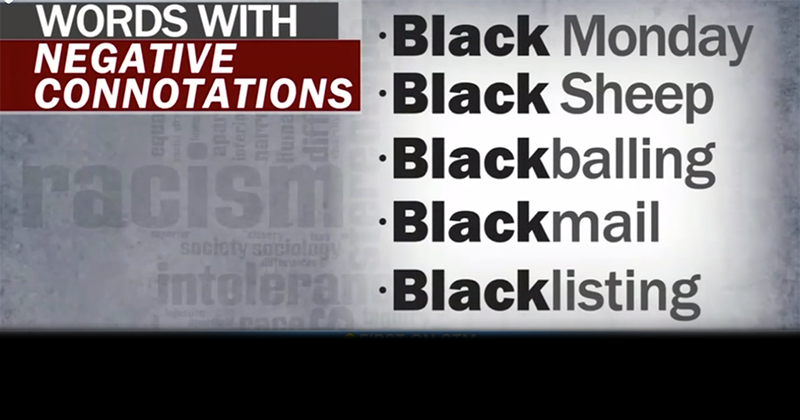
The Real Meaning of Black Monday


               The Real Meaning of Black Monday

The Spirit of 1619. CBS News wants to reeducate America on how racist everyone is by policing their language and making them understand that the country’s founding fathers were really awful bigots.


That’s the message that emerged from a Tuesday segment on This Morning where the anchors and their guests attempted to convince viewers that everyday terms with zero racial context are proof of how “the roots of racism” are deeply embedded in the US.

This is not just white noise and will not become a white elephant. These racists won't be able to whitewash this.


So we torture History with the enthusiasm of Torquemada, each ideologue providing his own Procrustean bed. 

Saturday, May 11, 2019

Valar Morghulis

To be able to recover his honor, a slave must necessarily adopt the rules and standards of the society that surrounds him, and this means that, in practice at least, he cannot absolutely reject the institutions that de­prived him of his honor in the first place."---Olaudah Equiano

Thomas graduated yesterday. we plan a picnic today but it is really cold.

I heard--did not read--of a study by the major U.S. sports organizations. There is concern about the downward trend in attendance. The assumption was that people were reacting to the cost of tickets, parking and food. But that was not what the study showed. People are finding the accessories of video broadcasts were much more entertaining than simple attendance. And that competition offered by technology is only going to improve.


A clever fraud was created to give the appearance of internet ad  views--ad views that could be billed for. Fake people with fake cookies and fake social-media accounts, fake-moving their fake cursors, fake-clicking on fake websites — the fraudsters had essentially created a simulacrum of the internet, where the only real things were the ads. In a larger view, studies generally suggest that, year after year, less than 60 percent of web traffic is human; some years, according to some researchers, a healthy majority of it is bot. 
For a period of time in 2013, the Times reported this year, a full half of YouTube traffic was “bots masquerading as people,” a portion so high that employees feared an inflection point after which YouTube’s systems for detecting fraudulent traffic would begin to regard bot traffic as real and human traffic as fake. They called this hypothetical event “the Inversion.”


Sen. Rick Scott (R., Fla.) disclosed this week that his wife Ann Scott bought millions of dollars in municipal bonds in April.
Rick Scott disclosed in a regulatory form that Ann Scott purchased $10.6 million to $33.5 million in 10 different issues of muni bonds from April 9 through 30. 

These politicians are just like us---only better.

We must be the most tolerant of peoples. Cue the mayor of San Francisco: “Tobacco use is the leading cause of preventable disease and death in the United States. Tobacco kills more than 480,000 people a year in this country. That’s more than AIDS, alcohol, car accidents, illegal drugs, murders, and suicides combined.” Therefore, he goes on — in one of the great non-sequiturs of history — he is going to ban ecigarettes, which have caused none of those deaths and could prevent them, but not ban real cigarettes, which caused nearly all of those deaths. This makes sense to him , presumably, because e-cigarettes has the word "cigarette" in it; he could as easily and logically banned the "cigarette power boat."
These people just say these crazy things, but the average guy is too busy--or too inured to the stupidity--to object. And attacking Trump will not make a difference. Trump is a caricature of the modern politician. The cat is out of the bag. The damage is done. We are ruled by morons.

On May 11, 1997, chess grand-master Garry Kasparov resigned after 19 moves in a game against Deep Blue, a chess-playing computer developed by scientists at IBM. This was the sixth and final game of their match, which Kasparov lost two games to one, with three draws.


                                      Valar Morghulis

Klingon and Elvish were the first two constructed fictional languages I encountered. Now there are the languages of GoT and Avatar. CNN, believe it or not, has an interesting story on such creations:

All the lines spoken in Valyrian -- a language split into many dialects and across various regions of the "Game of Thrones" world -- are linguistically correct. They were written by linguist David J. Peterson, who has created over 50 fictional languages, mostly for movies and TV shows. He constructed Valyrian like a real language nearly from scratch, complete with grammar and rules. All he had to build upon was a handful of words and sentences that author George R. R. Martin included in his "A Song of Ice and Fire" books, from which the series is adapted, such as "Valar morghulis" ("All men must die") and "Valar dohaeris" ("All men must serve").

Peterson also designed another of the fictional languages heard throughout "Game of Thrones": Dothraki, which is spoken by Jason Momoa's character Khal Drogo and his tribe. The linguist developed this language first, in response to an online competition launched by the show's producers before the series first aired.

"I applied, with many other very good language creators," Peterson said in a phone interview. "The competition had no upper limit on the amount of material you could provide. When I learned that, I spent every single minute of every day working on my proposal -- up to 18 hours a day sometimes. In about a month, I created over 300 pages of material, including grammar, translations and cultural phrases."

He won the competition, and was later asked to create Valyrian too. Today, Dothraki has about 4,000 official words, and Valyrian about 2,000. Popular online learning platform Duolingo has even included High Valyrian -- the noblest of Valyrian dialects, as spoken by Daenerys -- in its offerings, and to date 1.2 million learners have started the course. It is particularly popular in the UK, where 100,000 people have signed up to study it -- more than can speak traditional languages like Irish and Scottish Gaelic, according to Duolingo.

Among the best-known fictional languages, Klingon from "Star Trek" has enjoyed a cult following since the 1990s and its creator, Mark Okrand, regularly releases new words.
It, too, is available on Duolingo, and is one of several conlangs for which ample online resources are available, along with Na'vi from the 2009 blockbuster "Avatar" and Elvish from J. R. Tolkien's "Lord of the Rings" saga. (CNN)

Thursday, November 3, 2016

Esperanto

People can command, dictate, and legislate; however, people cannot consciously create law any more than people can consciously create human language.  Genuine law, like language, evolves; each is the result of human action but not of human design.--Bruno Leoni
 
L.L. Zamenhof  a Polish physician and inventor had an ambitious idea. He wanted to create a language that anyone could learn easily. In his mind, a simple, universal language would be uniting and communal, would promote harmony and world peace. He wanted to bridge differences between people, especially religious differences.  He designed Esperanto.
Zamenhof had three goals, as he wrote in 1887:
1) "To render the study of the language so easy as to make its acquisition mere play to the learner."
2) "To enable the learner to make direct use of his knowledge with persons of any nationality, whether the language be universally accepted or not; in other words, the language is to be directly a means of international communication."
3) "To find some means of overcoming the natural indifference of mankind, and disposing them, in the quickest manner possible, and en masse, to learn and use the proposed language as a living one, and not only in last extremities, and with the key at hand." (wiki)

 Zamenhof was Jewish, and many of Esperanto's earliest adopters were also Jewish. They connected with this new language that emphasized equality.
Its international motives inspired opposition and support. In Nazi Germany, there was an effort to forbid Esperanto because Zamenhof was Jewish, and due to the internationalist nature of Esperanto, which was perceived as "Bolshevist." In his work, Mein Kampf, Adolf Hitler specifically mentioned Esperanto as an example of a language that could be used by an international Jewish conspiracy once they achieved world domination. After the October Revolution of 1917, Esperanto was given a measure of government support by the new workers' states in the former Russian Empire and later by the Soviet Union government, with the Soviet Esperanto Association being established as an officially recognized organization. In his biography on Joseph Stalin, Leon Trotsky mentions that Stalin had studied Esperanto. However, in 1937, at the height of the Great Purge, Stalin completely reversed the Soviet government's policies on Esperanto; many Esperanto speakers were executed, exiled or held in captivity in the Gulag labor camps. Quite often the accusation was: "You are an active member of an international spy organization which hides itself under the name of 'Association of Soviet Esperantists' on the territory of the Soviet Union."
Until the end of the Stalin era it was dangerous to use Esperanto in the Soviet Union despite of the fact that it was never officially forbidden to speak Esperanto. (from wiki)

There are supposed to be about 1000 native speakers of Esperanto. It is estimated that anywhere between 200,000 and 2 million people speak the language worldwide. Devotees say Esperantists exist all over the globe, with especially large pockets in Europe, as well as China, Japan and Brazil.  Duolingo is planning an Esperanto app.  (Of note, some object to Esperanto because, they say, it was born in the 19th Century and, through its gender assignation of words, is sexist.)

Clearly this is a desirable idea. After all, with such a wonderful and optimistic motive, what could go wrong? We could start by outlawing some words as deviant or divisive. Then progress upward (heaven-ward?) We could insist on Esperanto as a core course in grade school. We could make it the language of the courts, or the news.
But the failure of Esperanto is instructive. Language is not a creation, any more than a culture or an economy is. These things evolve through need, error and success. They evolve. They are a part of the people who represent them and can not be imposed. Troops can not do it; neither can goodhearted academics.

Tuesday, October 4, 2016

"Climate"

The word "Climate" originally was geographic; it referred to an area of the earth. It is from the late 14th Century, "horizontal zone of the earth," Scottish, from Old French climat "region, part of the earth," from Latin clima (genitive climatis) "region; slope of the Earth," from Greek klima "region, zone," literally "an inclination, slope," thus "slope of the Earth from equator to pole," from root of klinein "to slope, to lean".
The angle of sun on the slope of the Earth's surface defined the zones assigned by early geographers. Early references in English, however, are in astrology works, as each of the seven (then) climates was held to be under the influence of one of the planets.
Shift from "region" to "weather associated with a region" perhaps began in Middle English, certainly by c. 1600. So the different regions have different weather. The climate is actually different from region to region. The current debate (soon to be outlawed) is over the generalized world climate. As such, sampling is challenging as regions are different.
The battle cry of "Climate Change" is peculiar as it has no opponents. It reminds me of the old definition of a sociologist: A man constantly amazed by the obvious. The very nature of the climate is that it changes--from region to region, from time to time, from season to season. When some climate hangs around for a long time it usually gets named, like a Period or an Epoch. The climate is dynamic.
Since Christ there have been three major shifts, the period at the time of Christ, the Medieval Warm Period (end of the 9th century to the 13th) and the Little Ice Age (1640s to 1690s). If the earth is episodically warmer now it would be the third time a definitive temperature increase has occurred since Christ.
It is interesting that the current "change" is seen as ominous, that the present is optimum. Such a view is the hallmark of the conservative.