Tuesday, April 7, 2020

The Imperial College London


                    The Imperial College London


A paper written by a team of 33 researchers at Imperial College London, a research-oriented science institution in South Kensington, was summarized recently by Tucker. This is from it.

Dr. Fauci’s latest admission: “I’ve looked at all the models. I’ve spent a lot of time on the models. They don’t tell you anything. You can’t really rely upon models.”

The economic suffering we are enduring right now was based on these models, amplified in their extremes by a click-hungry media apparatus that thrives in a crisis as in no other time.

There was precious little consultation with serious medical professionals (the pleas of 800 were ignored). Also ignored were a range of experienced epidemiologists with real track records as well as economists. There were no legislative votes, and no real public debate. The Constitution was ripped to shreds. Large numbers of people who, by virtue of the musical-chairs game of elections, happen to be holding office assumed dictatorial power and declare themselves wise enough to rend the social fabric between essential and non-essential and thus instantly wreck the dreams and lives of tens of millions of people.

Despite all the expertise out there, and tremendous efforts to beg caution, and despite all our pretensions at being a scientifically minded people, at all levels of society, there was genuine panic and the adoption of what seems like the medieval “miasma” theory of disease. It’s just in the air, everywhere, blowing around. Stay indoors! Get away. Cling to loved ones and hope for the best! Better yet, sit by yourself, alone in a room, until this ends!

That was six weeks ago. You still can’t get a test, unless you are very sick and hurl yourself at the hospital front door. That is the fault of government agencies, in a scandal that has been widely covered and will be told throughout the ages. That will surely be remedied in time, along with a much-needed antibody test for post-infection immunity.

All that said, we are finally getting at least some information to make sense of this disease. In particular: demographics. We are at least finding out for whom it is fatal and therefore can better focus mediation strategies on those in danger – which is essentially the core job of medical professionals since, well, since the ancient world. To the extent we can replace fear-based mythology, predictions, and state power with knowledge rooted in empirical realities, that is to say, actual facts, we get closer to comprehending the possibility of calm and focus on what matters.

What have we learned? I draw your attention to a complicated paper written by a team of 33 researchers at the now-famous Imperial College London. This difference between this paper and the others is that this one is rooted not in what statistical models predict based on malleable assumption but on the actual factual record. The paper: “Estimates of the severity of coronavirus disease 2019: a model-based analysis.”

For its conclusions, I’m relying on a summary in Statnews: What explains Covid-19’s lethality for the elderly?

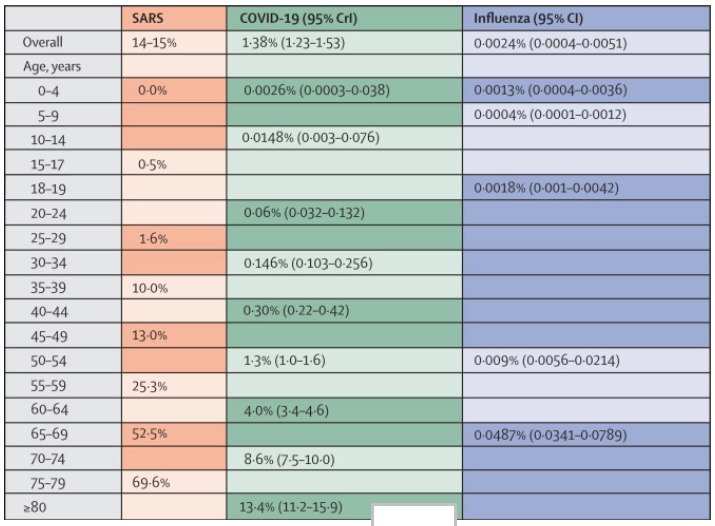
Researchers on Monday announced the most comprehensive estimates to date of elderly people’s elevated risk of serious illness and death from the new coronavirus: Covid-19 kills an estimated 13.4% of [infected] patients 80 and older, compared to 1.25% of those in their 50s and 0.3% of those in their 40s. The sharpest divide came at age 70. Although 4% of patients in their 60s died, more than twice that, or 8.6%, of those in their 70s did…

An accompanying editorial finally says what people are starting to realize: “the fatality rate is low for younger people.” It’s high for older, unhealthy people, but low for healthy younger people. That’s hugely important information for focusing the response.

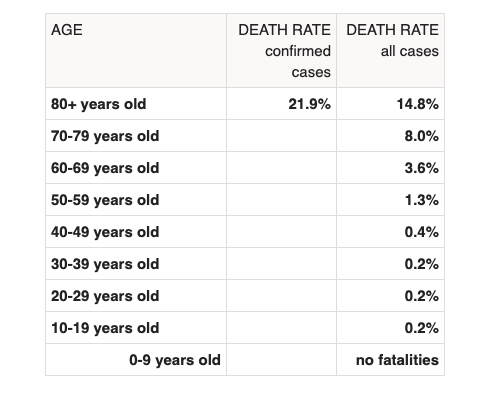
Worldometers presents the reality more clearly (but keep in mind that the precise case fatality ratio is unknown given the lack of random testing and potential misclassification; what matters here are the demographic disparities).


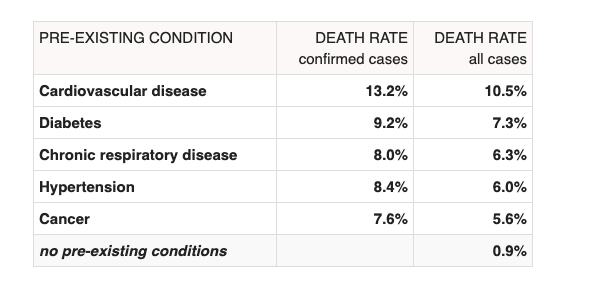
And from confirmed COVID patients with preexisting conditions:


Here is the breakdown and a comparison to SARS and seasonal flu (keeping in mind that this data is preliminary but the demographics are likely to hold true), demonstrating that even with preliminary data COVID-19 is more discriminatory by age/health than seasonal flu.


The authors of the Imperial College study point out that while this appears to be about age, we are really talking about the health of immune systems of which age is a statistical proxy. There is also a gendered risk too, with authors noting “tentative, sex-based differences in the COVID-19 epidemic, with elderly men generally faring worse than elderly women.”

How do these surprising demographics affect the fatality ratio, the number on which everyone obsesses because it is this that gives us an indication of whether this is “worse” or “not as bad as” the seasonal flu? It suggests that an aggregate number masks a huge disparity between groups.

In the outbreak’s early weeks that was thought to be as high as 3% to 8%. Instead, the fatality rate among people with confirmed disease is 1.38%, they concluded. That supports an estimate by researchers at the Harvard T.H. Chan School of Public Health earlier this month of a 1.4% fatality rate in confirmed cases. The British group said the fatality rate among all of those infected with the new coronavirus — including those who don’t have symptoms — is 0.66%.

That’s a huge difference from what people believed at the very outset, confirming that the cautions of John Ioannidis were right to introduce doubt about sweeping impositions of social, economic, and political change based on early perceptions, which have always been far more scary than the reality. It was 15 years ago that headlines blared the coming mass death from Bird Flu, with predictive epidemiologists demanding that schools and businesses close to protect us from the worst fate. That didn’t happen, although Bird Flu was deadly (all such viruses are), but the pandemic was not anywhere close to as bad as was predicted.

In sum, what researchers know now that they only suspected a few months ago is that coronavirus is mainly a threat to older people with health issues, and men in particular. That’s hugely important information and a far cry from the confused miasma theory (everyone is going to die!) that drove the panicked response.

To be sure, this does NOT mean younger people are in the clear – it’s a severe disease, and there are always exceptional cases that defy the demographic patterns, as with any disease. But the statistical evidence shows this is rare, whereas more severe complications for the sick and elderly are far more common.

Monday, April 6, 2020

Pandemics and The Environment


                   Pandemics and The Environment


This is from a Williamson article on how the pandemic and the reaction in The West is exactly what would be created by The Green New Deal. While obvious enough, it is still true.


The current crisis in the U.S. economy is, in miniature but concentrated form, precisely what the Left has in mind in response to climate change: shutting down large sectors of the domestic and global economies through official writ, social pressure, and indirect means, in response to a crisis with potentially devastating and wide-ranging consequences for human life and human flourishing.

What is underway right now in response to the epidemic is in substance much like the Green New Deal and lesser versions of the same climate-change agenda: massive new government spending, political control of critical industries, emergency protocols modeled on wartime practice, etc.

Set aside, for the moment, any reservations you might have about the coronavirus-emergency regime, and set aside your views on climate change, too, whatever they may be. Instead, ask yourself this: If Americans are this resistant to paying a large economic price to enable measures meant to prevent a public-health catastrophe in the here and now — one that threatens the lives of people they know and love — then how much less likely are they to bear not weeks or months but decades of disruption and economic dislocation and a permanently diminished standard of living in order to prevent possible severe consequences to people in Bangladesh or Indonesia 80 or 100 years from now?

A couple of months of this is going to be very hard to take. Nobody is signing up for a lifetime of it.

Sunday, April 5, 2020

Palm Sunday


Palm Sunday was always difficult when I was a child. The story was horrifying. And it was long. Relentless and long. Novel long. And novel deep. The suggestions and conflicts of this gospel are so important it is, objectively, hard to imagine that students are regularly deprived of it. What is Truth? Barabbas. Ecce homo. 
And these questions are universal, always reframed by every new age which gives us all a chance to rethink them from our newest, temporary vantage. Now, in the time of The Virus, it is hard not to think of Pilate, the region's most powerful man, vacillating before the crowd, too weak to do what is right, even before his own law.

This is the "Tchaikovsky Legend", from a poem by Stoddard:

https://www.youtube.com/watch?time_continue=15&v=X-Zwjn-2n_A&feature=emb_logo

When Jesus Christ was yet a child
He had a garden small and wild,
Wherein He cherished roses fair,
And wove them into garlands there.

Now once, as summer time drew nigh,
There came a troop of children by,
And seeing roses on the tree,
With shouts they plucked them merrily.

Do you bind roses in your hair?
They cried, in scorn, to Jesus there,
The Boy said humbly: "Take, I pray,
All but the naked thorns away."

Then of the thorns they made a crown,
And with rough fingers pressed it down,
Till on His forehead fair and young,
Red drops of blood like roses sprung.

Saturday, April 4, 2020

High-Level Estimates


                    High-Level Estimates

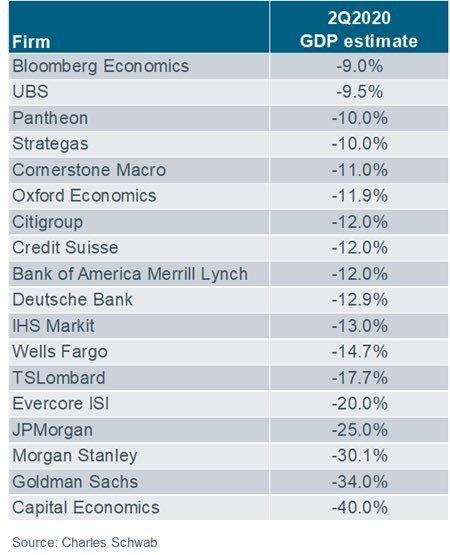
Here is a collection of the experts and their estimates of changes in the GDP from The Virus, second quarter. From their models. 

I understand that we are now in the Age of the Experts but does anybody know anything?

Friday, April 3, 2020

Price Gouging


                                 Price Gouging

From a press release from Nurse.org, a website for nurses publishing educational and employment information as well as discussion forums:

"This week, New York needs to hire at least 200 ICU and ED nurses for one of the largest health systems in the nation. This week’s projections show a huge influx of patients, including ICU, and hospitals are in dire need.

Here are some incentives that we’ve found from New York State and staffing agencies.

*Crisis Pay – Travel nursing agencies are offering crisis pay that is over double the average pay for travel nurses. We are seeing pay rates of over $10,000 per week plus quarantine pay.

*Free hotel rooms – several hotels, including the Four Seasons.

*Free car rentals – Hertz is offering free car rentals for healthcare workers

*Free airfare – Delta and Jetblue are offering free flights to medical workers who are helping tackle the COVID-19 pandemic.

*Discounts and offers – Businesses are also offering incentives, not only to travel nurses but to all nurses. From free crocs shoes and free Starbucks coffee to discounts on scrubs, we’ve collected all the specials and you can see the offers here."

Sooo...will there be charges for price gouging brought here?

Thursday, April 2, 2020

Is a Shutdown an Overreaction?


From a blog by a guy named Mulligan. It got some angry response. The 90K is a bit hard for me to believe, based on the South Korean numbers:

                     Is a Shutdown an Overreaction?

60,000 - 80,000 Americans died from the 2017-18 flu, without exceeding the capacity of ICU beds. This flu was experienced around the world. Not a single country found it worth shutting down their economies in that situation.

In 2020 the forecast is that about 90,000 Americans will die from COVID-19, including some deaths due to insufficient ICU capacity. Shutting down "nonessential" businesses is now the norm.

This forecast comes from the Institute for Health Metrics and Evaluation IMHE at the University of Washington. Unlike me, IMHE are not amateurs with contagious disease time series. With "about 500 statisticians, computer scientists, and epidemiologists on staff, IHME is a data-crunching powerhouse. Every year it releases the Global Burden of Disease study...."

At what point is a reasonable person allowed to ask why the economic policies of 2017-18 and 2020 are so disproportionate?
Some people will say that the 90,000 would have been much higher without shutting down the economy. At what point can a reasonable person follow up with "Why were ALL of the 2020 costs, which were in the $ trillions, taken on the economic (and civil liberty) side of the ledger, and essentially NONE on the mortality side?"

Wednesday, April 1, 2020

China Baloney


                                China Baloney

At times of anxiety, we poor humans are inundated with a lot of posturing and baloney. The anxiety over calling The Virus "The China Virus" is a great example of both. The incredible efforts of the Chinese to propagandize the crisis aside, there is some real stupidity here. Below is an article by McGurn from the WSJ:


"Amid the coronavirus wreckage, there seems to be a bright spot. The pushback against referring to Covid-19 as the “China virus” indicates a welcome new sensitivity for the racial discrimination directed at Chinese-Americans. Or does it?

Ever since people began referring to “the China virus”—or to be precise, ever since the White House press corps realized it was Donald Trump’s preferred term—the American people have been given repeated warnings that this is not only insensitive but dangerous.

It’s hard not to notice the chasm between this new hypersensitivity and the indifference toward another, very real discrimination affecting this same community. That is the racial discrimination keeping Chinese-Americans out of America’s most elite educational institutions. Some of the same people who fret so loudly about how we refer to Covid-19 are utterly indifferent to this other racial discrimination affecting Chinese-Americans.

Start with the mayor of New York, Bill de Blasio. After Mr. Trump tweeted out a reference to “the China virus” earlier this month, Mr. de Blasio clapped back. Asian-Americans, the mayor thundered, “don’t need you fueling more bigotry.”

If someone fuels bigotry by calling a virus a name accurately derived from its geographic origins, what about a mayor who works overtime to reduce the number of Asian-Americans in his city’s most competitive public high schools, not because they haven’t earned their entry but because they aren’t the right race.

Ditto for Harvard. Remember, the chief argument against “the China virus” is that using it stigmatizes both China and people of Chinese descent. But what about the stigmas that come from the subjective “personal ratings” Harvard applies in its admissions process? The Justice Department says these ratings produce “consistently poorer scores for Asian-Americans,” a racial penalty that brings down an Asian-American applicant’s overall score.

Asian-Americans as a whole score higher “on many objective measures than any other racial/ethnic group including test scores (see chart below), academic achievement, and extracurricular activities.” But if we are to believe Harvard, Asian-Americans are less likable, less kind and less courageous than those of other races. If that’s not stigmatization, what is?

….. “xenophobia wears many faces.” And in a nation of 330 million, America has its share of goons. What’s Harvard’s excuse?"