Tuesday, February 14, 2023

Baked In


In 2022, there were more than 600 mass shootings in the U.S. in which at least four people were killed or injured, according to the Gun Violence Archive.

***

A highly drug-resistant strain of gonorrhea has been detected in the U.S. for the first time, raising concerns among public health officials about the scarcity of treatments and a future when gonorrhea could become untreatable.
The Massachusetts Department of Public Health said on Jan. 19 that it had detected two cases of a novel strain of gonorrhea that was more impervious to existing antibiotics than any other strain previously recorded in the U.S.

***

The families, who filed their suit on Thursday, say dealers used snapchat to communicate with their kids to sell fake prescription drugs, many of which were laced with fentanyl, and that the popular app ultimately helped lead to the deaths of their children.
According to a report by ABC News, Snapchat was implicated in 75% of overdose deaths among teens 13 to 18. The main reason for its popularity among drug dealers is that the app has features that are conducive to illegal activity – specifically, messages disappear after being sent, so there’s no evidence of deals.

***


Baked In

Jack Phillips’ successful U.S. Supreme Court case concerned his refusal to make a same-sex wedding cake. He said he could not bake a cake for a ceremony his religion opposed. Not people, ceremony.

He now faces a civil lawsuit for declining to make a cake celebrating a purported gender transition of a transgender-identifying attorney. Again he states he is happy to make the person a birthday cake but can't make a cake celebrating something his religion opposes. (He doesn't make Halloween cakes either.)

So the edge of the culture is hunting this guy? Will he be subjected to social tests for the rest of his life? Is the idea here to break him? Make him change his mind? Is this the agenda for outliers?

And will we be forced to pay for these little projects?

What is wrong with these people?

Monday, February 13, 2023

Eritrea

I have known a vast quantity of nonsense talked about bad men not looking you in the face. Don't trust that conventional idea. Dishonesty will stare honesty out of countenance, any day in the week, if there is anything to be got by it. -Charles Dickens, novelist (7 Feb 1812-1870)

***

Dozens of students walked out of their New Hampshire school after the district banned urinals in a compromise to a proposal that would have blocked children from using facilities based on their gender identity.

***

Since the Supreme Court struck down previous restrictions on sports betting in 2018, 36 states have legalized it (26 of which allow mobile betting), and new ballot initiatives are proposed every year.

***

Eritrea

"Occupied," on Netflix, is a Norwegian-produced series conceived by the author Jo Nesbo, originally released in 2015. It has a mixed reputation, the first two seasons is apparently of high dramatic quality, then they lost their minds and thought they could run the thing for ten years and jumped the shark. A fourth season is coming.
One actress in the show is a woman named Selome Emnetu. She is a Norwegian actress, born in 1981 in Stavanger, Norway. She studied acting for three years at the Oslo National Academy of the Arts. She is of Eritrean descent.

Eritrean?
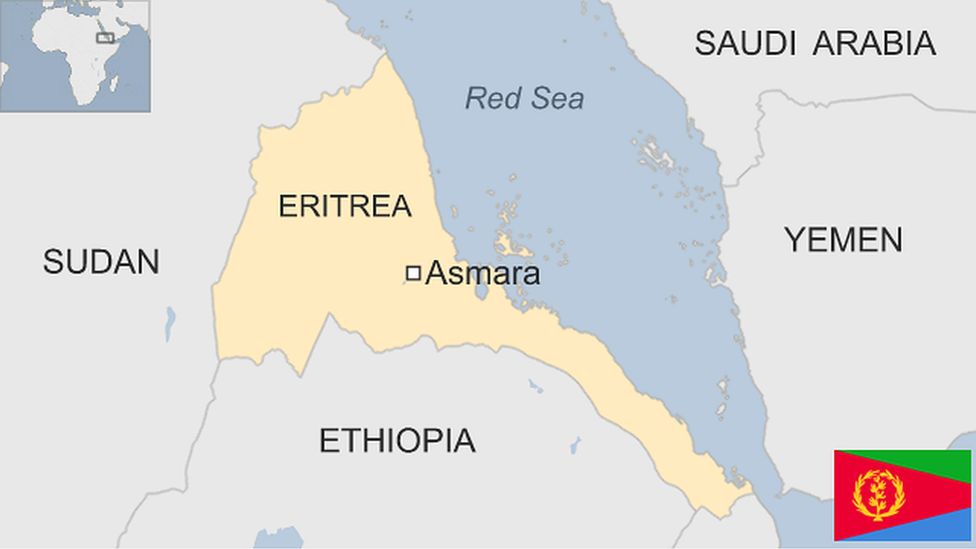
Map of Eritrea

Eritrea won independence from Ethiopia in 1993 after a 30-year war


Eritrea is located in East Africa. It is bordered to the northeast and east by the Red Sea, Sudan to the west, Ethiopia to the south, and Djibouti to the southeast

Capital: Asmara

Area: 117,600 sq km

Population: 6.2 million

Languages: Tigrinya, Tigre, Arabic, English, Beja, Kunama, Saho, Bilen, Nara, Afar

Life expectancy: 64 years (men) 68 years (women)

The country has a single party and has had one leader since independence, President Isaias Afewerki, Eritrea has no legislature, no independent civil society organizations or media outlets, and no independent judiciary.

The name Eritrea is derived from the ancient Greek name for "Red," the Red Sea.

At Buya in Eritrea, one of the oldest hominids representing a possible link between Homo erectus and an archaic Homo sapiens was discovered by Eritrean and Italian scientists. Dated to over 1 million years old, it is the oldest skeletal find of its kind and provides a link between hominids and the earliest anatomically modern humans.

Around 2000 BC, parts of Eritrea were most likely part of the Land of Punt, first mentioned in the twenty-fifth century BC.

The Red Sea became important with the completion of the Suez Canal and Eritrea was taken over by The Kingdom of Italy in 1889. 

The Italians lost the area in WWll and the British took over. After insistence by Halle Salasi, Eritrea was merged in a sort of federation with Ethiopia until it was granted independence after a 30-year resistance war.

Sunday, February 12, 2023

Sunday/Marcion


Claims that real hourly earnings and real median household income have stagnated in postwar America and that the poverty rate has remained unchanged for fifty years are solely the result of a failure by the statistical agencies of the American government to count most transfer payments as income and to use the most accurate available price indexes to adjust for inflation.--from the myth of American inequality

***

Microsoft plans to release technology to help big companies launch their own chatbots using the OpenAI ChatGPT technology, a person familiar with the plans told CNBC.
Companies would be able to remove Microsoft or OpenAI branding when they release chatbots developed with the software.

***

“Rent control appears to be the most efficient technique presently known to destroy a city—except for bombing.”--Assar Lindbeck

***


Sunday/Marcion

Marcionism was a religious movement based on the teachings of the 2nd-century heretic Marcion of Sinope. While, unsurprisingly, none of Marcion’s writings have survived to the present, we know of his teachings through several early Christian writers including Justin Martyr (AD 100—165), Irenaeus of Lyons (AD 130—200) and Hippolytus (AD 170—235) who wrote in opposition to him.  

Marcion was an Arian, but he is primarily known for his belief that the Old Testament Scriptures were not authoritative for a Christian. He denied that the God of the Old Testament was the same God presented in the New Testament. For Marcion, the God of the Old Testament and the God of the New were, literally, two different gods. He 
did not deny the existence of the god of the Old Testament (what he referred to as a 'Demiurge'). He simply classified this god as a secondary deity, one that was inferior to the supreme God revealed in Jesus.

The Old Testament God is centered on Israel and is violent in defending the growing nation. He is reminiscent of a noncommissioned officer as He organizes and develops His people. Christ in comparison seems more inclusive as He delivers a message of hope. And forgiveness.

There is a wonderful sociological logic here and it has stimulated some fiction writing, pitting one testament god against the other. 

Marcion did more than take the Old Testament in context, he had to delete a lot of the New Testament, too. This gospel is one of them.

How would Marcion accommodate these?

"Do not think that I have come to abolish the law or the prophets.
I have come not to abolish but to fulfill.
Amen, I say to you, until heaven and earth pass away,
not the smallest letter or the smallest part of a letter
will pass from the law,
until all things have taken place."

"whoever kills will be liable to judgment.
But I say to you,
whoever is angry with brother
will be liable to judgment;
and whoever says to brother, 'Raga,'
will be answerable to the Sanhedrin;
and whoever says, 'You fool,'
will be liable to fiery Gehenna."

and, the Carter-killer,

"You have heard that it was said,
You shall not commit adultery.
But I say to you,
everyone who looks at a woman with lust
has already committed adultery with her in his heart."


Saturday, February 11, 2023

Balloongate

Balloongate

Another spy ship? Are these people just foolish? Or careless? Or are we just the butt of a bunch of dangerous jokers? Or are these the product of the greatly underestimated, mysterious, and dangerous Unangax people?

***

What if they're not testing us? What if they're just dumb?

***

Why was the second balloon worthy of shooting down and the first not? The talk about commercial risk is weak because the first was powered and guided up and down through commercial levels as well.

***

One thing that is a direct result of this sneaky, insincere, aggressive behavior and the feckless American response is the average guy is now aware of China's risk and the danger posed by the meandering American response. Was that a smart thing for China to do?

***

If we put some Chinese companies on a 'forbidden list,' will that work or will they just change their names?

***

Ford is building a lithium plant in partnership with a Chinese battery company in Michigan. Is that a good idea?

***

The Chinese are not answering the emergency phone. Pique? Childishness? What is the point of the emergency phone if there is a policy not to answer it?

***

Maybe we should hire the balloon guys to monitor the southern border.

Friday, February 10, 2023

Disasters


The Richmond FBI prepared a memo on what it called “Radical Traditionalist Catholics” and the threat they posed, as a potential recruiting ground for ethnically motivated right-wing extremism.

***

Political and military figures in Germany have suggested a return of compulsory military service after the new defense minister described the 2011 phase-out of general conscription as a “mistake” that had contributed to alienating the general public from civic institutions.

***

Black students have lower six-year completion rates for any kind of degree or certificate program than students in any other racial or ethnic group, a new study has found.

***


Disasters

The Turkey/Syria earthquake so far has killed over 21,000.

The World Atlas has a list of what they think are the deadliest natural disasters in the 20th Century.

A natural disaster is defined by the World Health Organization as "an act of nature of such magnitude as to create a catastrophic situation." Some of the most common natural disasters are hurricanes, earthquakes, floods, and tsunamis. The 20th century (1901-2000) saw many catastrophic events take place, some of which are considered to be deadliest natural disasters of all time.  

War and stupidity are not included


10. Erzincan Earthquake

The 1939 Erzincan earthquake struck the eastern region of Turkey on December 27 with a magnitude of 7.8. The earthquake occurred on the North Anatolian Fault Zone and created a 223-mile-long surface rupture, which devastated the village of Erzincan and villages along the Iran border. It is believed that 20,000 people died as a direct result of the earthquake, but by January 5, the death toll rose to 30,000 due to blizzard conditions and floods. Erzincan was so badly destroyed due to the earthquake, the site was completely abandoned and a new settlement was found further to the north.


9. Manjil-Rudbar Earthquake

The destruction caused by Manjil-Rudbar earthquake. Image credit: M. Mehrain, Dames and Moore./Public domain


In 1990, a 7.4 magnitude earthquake occurred in the Gilan Province between Iran’s northern towns of Manjil and Rudbar. The earthquake was the largest to ever be recorded in that part of the Caspian Sea region. Rescue missions were hindered by adverse weather conditions and roads were blocked by extensive landslides as a result of the earthquake. Around 100,000 buildings collapsed and between 35,000 to 50,000 people were killed. The total cost of the damages was USD 8 billion.

8. Eastern Guatemalan Floods


In 1949, a violent storm triggered a series of devastating floods across Guatemala. The floods lasted for two weeks and caused huge social, economical and financial impacts. It was reported that the floods had destroyed most of Guatemala’s infrastructure; the cost of the damages was estimated between USD 15 million and USD 40 million. 40,000 people lost their lives as a result of the floods. Landslides caused further devastation to the country; the towns of Escuintla, San Marcos and Quezaltenango were some of the worst affected by the natural disaster.


7.
Quetta Earthquake

More details Opera Talkies, a cinema set up for the recreation of the soldiers, was destroyed in the quake.


On May 31, 1935, the city of Quetta in Pakistan was hit by a 7.7 magnitude earthquake. The entire city was destroyed, as well as nearby towns, and an estimated 30,000 to 60,000 people died from the impact. Thousands of people were injured and many were left homeless. The largest aftershock from the earthquake measured at 5.8 on the Richter scale and seriously affected the towns of Mastung, Kalat and Maguchar. The disaster is considered to be the 23rd deadliest earthquake worldwide to date.

6. Tokyo-Yokohama Earthquake

A view of the destruction in Yokohama


At approximately midday on September 1, 1923, a 7.9 magnitude earthquake struck the Tokyo-Yokohama metropolitan area. The earthquake ravaged the city, more than half of brick buildings and one-tenth of reinforced concrete structures collapsed. Hundreds of thousands of homes were destroyed, many were burned down by the fires triggered by the earthquake. The earthquake also generated a tsunami on the Sagami Gulf, which demolished 150 homes and killed 60 people. The overall death toll from the earthquake and its aftermath exceeded 140,000.

5. Tangshan Earthquake

1976 Tangshan earthquake site. Image credit: The National Oceanic and Atmospheric Administration/Public domain


The Tangshan earthquake of 1976 or the Great Tangshan earthquake took place on July 28, 1976, in China. With a magnitude of 7.9, the natural disaster ravaged the coal-mining city and killed 242,000 people. The death toll is one of the highest in recorded history. 700,000 people were injured as a result of the earthquake and infrastructure damage was extensive; more than 75% of unreinforced homes and buildings were destroyed. Later on in the day, an aftershock occurred in the city of Luanxian, 43 miles from Tangshan. This caused additional damage and more casualties.

4. Bhola Cyclone

Image of the Bhola cyclone taken on November 11, 1970.


On November 11, 1970, a cyclone hit Bangladesh and produced mass storm-surge flooding, which devastated the country’s low-lying lands. The event is the world’s deadliest tropical cyclone ever recorded. The cyclone began over the Bay of Bengal before traveling northward, gaining intensity as it moved. When it made contact with the land in Bangladesh, it devastated villages and farmlands; the most severely affected areas were Upazila and Tazumuddin, where over 45% of the population was killed by the tropical storm. In total, at least 500,000 people lost their lives as a result of the Bhola cyclone.

3. The Indian Famine

Government famine relief, c. 1901, Ahmedabad
At the turn of the 20th century, India was devastated by a famine that affected an area of 476,000 square miles and impacted 60 million people. The famine began as the monsoon rains failed in 1899, this caused a drought and resulted in crop failures and famine. The Central Provinces and Berar, the Bombay Presidency and the Ajmer-Merwara province were just some of the badly affected areas. Over two years, from 1899-1901, it was estimated that over 9 million people died as a result of the famine.

2. Yellow River Flood

Yellow River(Huang He), Lanzhou Gansu , China. Image credit: Faye kao/Shutterstock.com
The Huang He or Yellow River is a river in China that was prone to flooding. It caused three deadly floods in 1887, 1931 and 1938. However, the river flooded again in 1958 due to torrential rains exceeding 100mm of rain per day. The flood affected 741,000 people and destroyed hundreds of thousands of homes in more than 1,700 villages. More than half a million acres of crops were completely submerged. It was reported to be more destructive than the 1931 flood, which left 80,000 people homeless and killed between 850,000 to 4,000,000.

1. Yangtze River Floods

An overflowing Yangtze River in the present day. Image credit: Humphery/Shutterstock.com
Torrential rains hit southern China in August 1931 and caused the Yangtze River to flood. The river was already at maximum capacity due to heavy rains that fell in April. The Yangtze floods covered more than 30,000 square miles, causing more than 40,000,000 people to lose their homes and croplands. 15% of the wheat and rice crops of the Yangtze Valley were completely destroyed. The flood killed 3.7 million people both directly and indirectly, with many people dying from poor sanitation and diseases.

Thursday, February 9, 2023

Prosperity Without Wealth


"Once again I am caught in the glare of ageism and misogyny that permeates the world we live in."--Madonna, responding to criticism of her appearance at the Grammys

***

The top 10 percent of households in the United States earn about 33.5 percent of all income, but they pay 45.1 percent of income-related taxes, including Social Security and Medicare taxes. In other words, their share of all income-related taxes is 1.35 times larger than their share of income. That is the most progressive income tax share of any OECD nation. In Germany, the top 10 percent earn 29.2 percent of the income and pay 31.2 percent of income-related taxes, 1.07 times their share of income. The French top 10 percent earn 25.5 percent of the income and pay 28.0 percent of the income taxes, 1.10 times their share of income.--Gramm et al

***

maps-that-will-make-you-view-the-world-i

Tracking Of An Eagle Over A 20 Year Period  

***

Prosperity Without Wealth

Stuppa writing on the strange paper in Nature on 'degrowth,' subtitled “Wealthy countries can create prosperity while using less materials and energy if they abandon economic growth as an objective:”

'To begin with, it is sad to see one of the most prestigious journals (the same journal that published the Watson and Crick paper on DNA…) is publishing this kind of rubbish. The article does not have a single piece of data. It is just a manifesto for a deindustrialization of the west, filled with naïve and simplistic comments. For example “it is necessary to ensure universal access to high-quality health care”. Nobody disagrees, but do they realize that such health care requires expensive doctors, expensive medications, expensive machinery (MRI, CAT, etc.)? And why would big pharma invest in discovery if their board of directors are more interested in the environment than they are in dividends and returns? And why would a kid invest 10+ years in becoming a doctor, with gruesome hours, if he cannot make a bunch of money at the end? Sure…love for humanity, etc etc, but at the end if you leave it to passion we simply won’t have enough people to go around.

But what is even more sad is to see that most of the authors are very successful and highly published and highly cited academics. This tells us that this is not a fringe movement. It is a movement that, in Gramsci’s words, has accomplished the long march in the institutions, and now controls funding, publications, etc.'

Just an estimate of costs of this brave new world. The ten-year assumption of the cost of universal healthcare would be an additional $30 to $40 trillion dollars. Trillion. Additional.

And Freeman in the WSJ on the same article:

'Prosperity without profits? The piece goes on to suggest plans for universal income and canceling international debts and by now readers may be getting the feeling that this is not so much about saving the environment as it is about tearing out the institutions of capitalism root and branch.'

Wednesday, February 8, 2023

UK's Economy


A construction worker in 2020 produced less than a construction worker in 1970, at least according to the official statistics. Contrast that with the economy overall, where labor productivity rose by 290 percent between 1950 and 2020, or to the manufacturing sector, which saw a stunning ninefold increase in productivity.

***

Around seven in 10 people in Haiti back proposed the creation of an international force to help the national police fight violence from armed gangs who have expanded their territory since the 2021 assassination of President Jovenel Moise, according to a survey carried out in January.

***

ChatGPT, the popular chatbot from OpenAI, is estimated to have reached 100 million monthly active users in January, just two months after launch, making it the fastest-growing consumer application in history, according to a UBS study on Wednesday.

***

UK's Economy

Some hard times may be coming in Great Britain.

In December, as many as 500 patients per week were dying in Britain because of E.R. waits, according to the Royal College of Emergency Medicine, a figure rivaling (and perhaps surpassing) the death toll from Covid-19. On average, English ambulances were taking an hour and a half to respond to stroke and heart-attack calls, compared with a target time of 18 minutes; nationwide, 10 times as many patients spent more than four hours waiting in emergency rooms as did in 2011. The waiting list for scheduled treatments recently passed seven million — more than 10 percent of the country — prompting nurses to strike. The National Health Service has been in crisis for years, but over the holidays, as wait times spiked, the crisis moved to the very center of a narrative of national decline.

There's more.

"GDP is a simple multiplier of two factors: people and their productivity. But we don’t have people we need, nor the productivity,” CBI director general Tony Danker added.


The United Kingdom is the only G7 economy that hasn’t recovered fully from the pandemic. Soaring energy and food costs drove inflation to a 41-year high in October. Widespread strikes have become the norm recently as workers feel the sting of a worsening cost-of-living crisis.

UK workers suffered the most significant drop in their spending power in more than 20 years between April and June as average real wages — which take inflation into account — fell by 3%. The drop in real wages was less severe in the third quarter but was still one of the largest since official records began in 2001.

By the end of next year, the average British family will be less well off than the average Slovenian one, according to a recent analysis by John Burn-Murdoch at The Financial Times; by the end of this decade, the average British family will have a lower standard of living than the average Polish one.