Showing posts with label gun. Show all posts

Saturday, November 28, 2020

Some Stats


                                                                      Some Stats

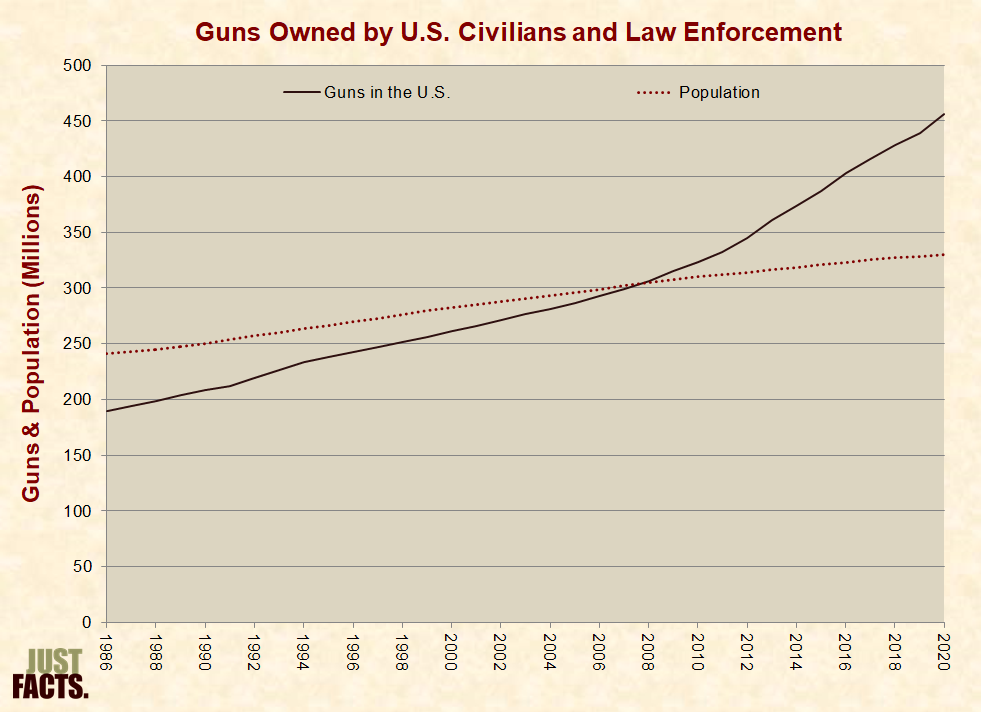
In the United States during 2018, civilians and domestic law enforcement owned about 426 million firearms or an average of 1.3 firearms per person.[243] This increased from 0.8 firearms per person in 1986:

Guns Owned by U.S. Civilians and Law Enforcement


 Handguns comprised 55% of all new guns sold to civilians and law enforcement in 2018, which is an increase from 35% in 2000:[245]

Handguns as a Portion of New Firearms Sold to U.S. Civilians and Law Enforcement


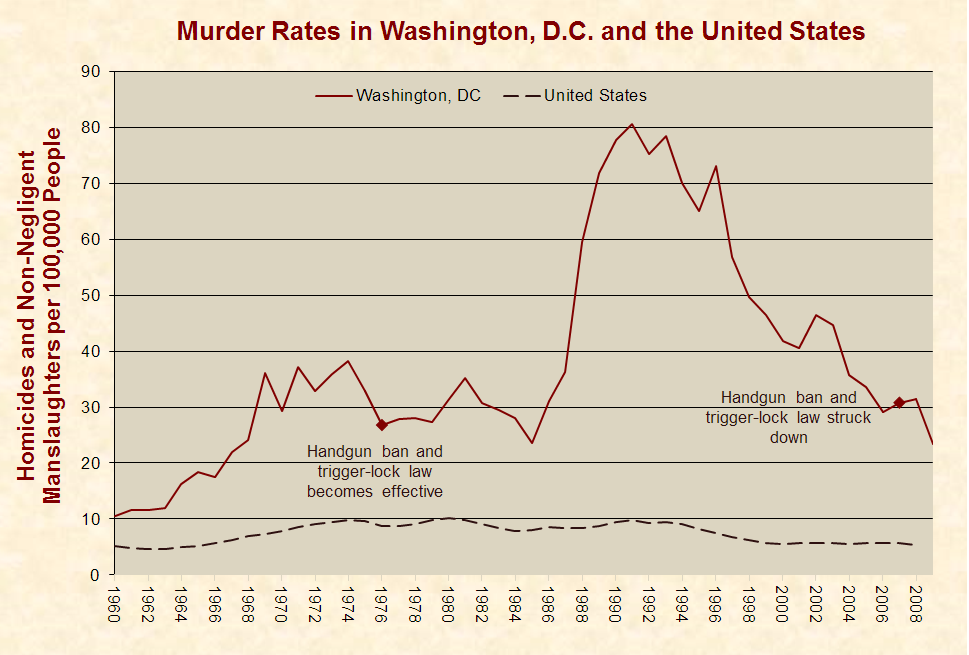
Murder rates in Washington D.C. and the entire United States were as follows:

Murder Rates in Washington, DC


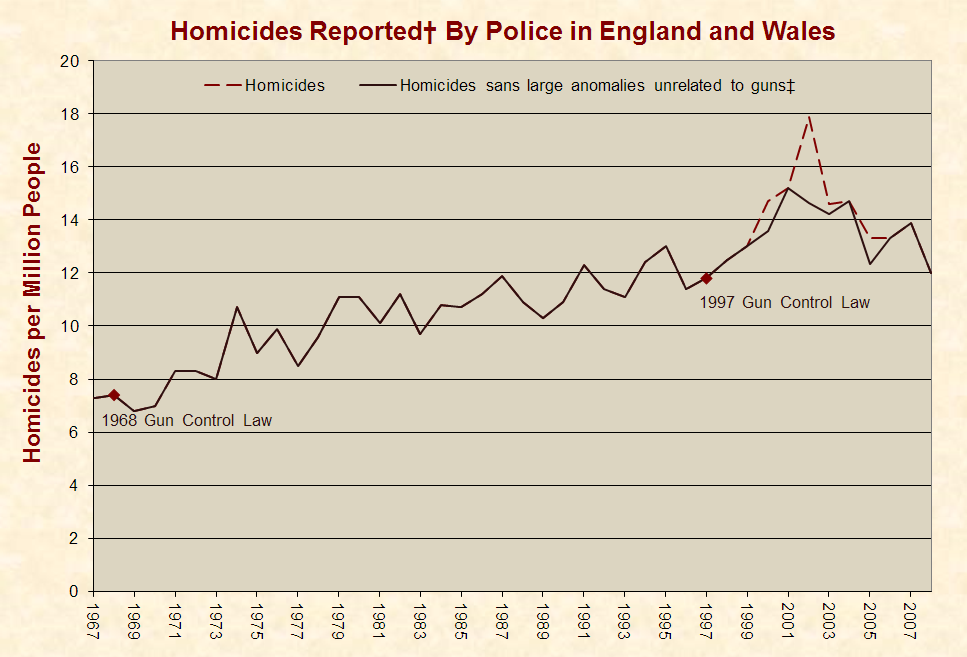
Murder rates in England and Wales were as follows:

Murder Rates in England


Sunday, August 4, 2019

Sunday/Guns

The contest for ages has been to rescue liberty from the grasp of executive power--Daniel Webster

Dinner with the McGraws at the PGC. Always get the hamburger.

The Feds are looking into possible campaign finance misdeeds by Rep. Alexandria Ocasio-Cortez’s chief of staff and lead rainmaker, who suddenly resigned Friday, federal sources told The Post.

Re the girl who jumped from the plane in Madagascar:
According to her uncle, Lester Riley, "She had taken ill after being there for a few days, and when she spoke to her mother on the phone two days before the accident, she was mumbling and sounded pretty incoherent," he said. Police claim that Cutland, who had been studying natural sciences as a second-year student at Cambridge University, had also experienced at least five paranoia attacks and was "stressed" the day of her death. Riley added that his niece had never shown any signs of mental illness prior to last month's incident.

From the WSJ: The American middle class is falling deeper into debt to maintain a middle-class lifestyle. Cars, college, houses and medical care have become steadily more costly, but incomes have been largely stagnant for two decades, despite a recent uptick. Filling the gap between earning and spending is an explosion of finance into nearly every corner of the consumer economy. Consumer debt, not counting mortgages, has climbed to $4 trillion—higher than it has ever been even after adjusting for inflation. Mortgage debt slid after the financial crisis a decade ago but is rebounding. Student debt totaled about $1.5 trillion last year, exceeding all other forms of consumer debt except mortgages. Auto debt is up nearly 40% adjusting for inflation in the last decade to $1.3 trillion. And the average loan for new cars is up an inflation-adjusted 11% in a decade, to $32,187, according to an analysis of data from credit-reporting firm Experian. Unsecured personal loans are back in vogue, the result of competition between technology-savvy lenders and big banks for borrowers and loan volume.

                         Guns

Very interesting gospel on the physical versus the spiritual world. And the abstract always wins. But there is a real practical question in the land today.There were two more mass murders this weekend. The recurring question will be, "Can we humans manage our freedom?" 
Do we need the supervision of government to protect us from the devils of our lesser nature?


The United States has 270 million guns and had 90 mass shooters from 1966 to 2012.
No other country has more than 46 million guns or 18 mass shooters — the U.S. is way worse than the Philippines, Russia, China or India.

The mass murder problem in the U.S., statistically, comparable to other nations. It is, however, so dramatic that it will be the strongest argument the statists have that the individual can not manage freedom and needs tighter control.
But we do know a lot about mass murders and murderers. The question is, will we prefer form over substance?

http://steeleydock.blogspot.com/2015/10/guns.html

https://steeleydock.blogspot.com/2018/03/gun-numbers.html

https://steeleydock.blogspot.com/2018/02/scalia-and-gun-control.html

https://steeleydock.blogspot.com/2017/10/guns.html

https://steeleydock.blogspot.com/2016/03/guns.html

https://steeleydock.blogspot.com/2015/12/san-bernardino.html

http://steeleydock.blogspot.com/2013/01/fun-with-numbers.html

Thursday, March 1, 2018

Gun Numbers

Some numbers on guns. These numbers are just that: Numbers. They are neither observations nor explanations. There is a wonderful short story by Borges where the weapon has a spirit.
That is a lovely image but in the real world there are probably other factors. But without doubt, any analysis and decision about this problem will be made by emotions.
 
There are about 300 million firearms in the U.S., 75 million gun owners, and about 3-5 deadly mass shooters each year. That means 0.000006% of gun owners each year are mass shooters.

With the toughest gun laws in the nation, Chicago saw homicides jump to 513 in 2012, a 15% hike in a single year. The city’s murder rate is 15.65 per 100,000 people, compared with 4.5 for the Midwest, and 5.6 for Illinois.

One is approximately twelve times more likely to die from farm machinery than from a mass shooting.

Last year, the National Shooting Sports Foundation reported that participation by women increased both in target shooting (46.5%) and hunting (36.6%) over the past decade. Also, 61% of firearm retailers responding to a NSSF survey reported an increase in female customers. A 2009 NSSF survey indicated that the number of women purchasing guns for personal defense increased 83 percent.

31 percent of adults reporting having a firearm in their household in 2014. That is 17 percentage points below the peak gun ownership from 1977 to 1980.

Fifty-five percent of the homicide victims were black, far beyond their 13 percent share of the population.

While blacks are significantly more likely than whites to be gun homicide victims, blacks are only about half as likely as whites to have a firearm in their home (41% vs. 19%).

One is  roughly three times more likely to die from lawnmowers than from a mass shooting.

Since at least 1950, all but two public mass shootings in America have taken place where general citizens are banned from carrying guns.

According to Pew, gun-related homicides in the late 2000s were “equal to those not seen since the early 1960s.” Yet their survey found that 56 percent believed gun-related crime is higher, 26 percent believed it stayed about the same, and 6 percent didn’t know.  Only 12 percent of those polled thought it was lower.
The Pew survey found that while women and elderly were actually less likely to become crime victims, they were more likely to believe gun crime had increased in recent years.

More than twice as many people are murdered by people with their hands and feet than by rifles or shotguns each year, according to FBI Crime Statistics.

Blunt objects kill far more than either rifles or shotguns.

"Less than half of Americans, 47%, say they favor stricter laws covering the sale of firearms, similar to views found last year," Gallup says. "But this percentage is significantly below the 58% recorded in 2012 after the school shooting in Newtown, Connecticut, spurred a nationwide debate about the possibility of more stringent gun control laws. Thirty-eight percent of Americans say these laws should be kept as they are now, and 14% say they should be made less strict."

Knives kill over six times as many people as either rifles or shotguns. 

FBI Crime Statistics show that all rifles combined — “assault rifles,” hunting rifles, all rifles — account for 250 firearms homicides per year. That is fewer than 2% of all homicides each year. By comparison, handguns account for nine times as many murders as all other firearms combined.

Corrected for population, the U.S. is eleventh in the world in terms of death rate from mass shootings per year.

According to DOJ’s Bureau of Justice Statistics, U.S. gun-related homicides dropped 39 percent over the course of 18 years, from 18,253 during 1993, to 11,101 in 2011. During the same period, non-fatal firearm crimes decreased even more, a whopping 69 percent.

In an average month, 50 women are shot to death by intimate partners in the U.S..

Corrected for population, the U.S. drops from the nation with the ‘most mass shootings in the world’ to the twelfth highest.
Tuesday, February 27, 2018

Scalia and Gun Control

Is it possible to define the kinds of weapons that should not be in civilian hands, and does regulating them violate the Second Amendment?
Here is Justice Antonin Scalia quoted in a NYT editorial a few years ago, writing the majority opinion in District of Columbia v. Heller, in which the Supreme Court reversed a long-held position and ruled that the Second Amendment did give Americans an individual right to own firearms. The court said the District’s ban on handguns in private homes went too far, but that regulation of gun ownership was compatible with the Second Amendment:

“We also recognize another important limitation on the right to keep and carry arms. ‘Miller’ said, as we have explained, that the sorts of weapons protected were those ‘in common use at the time.’ 307 U.S., at 179, 59 S.Ct. 816. We think that limitation is fairly supported by the historical tradition of prohibiting the carrying of ‘dangerous and unusual weapons.’”
Justice Scalia also wrote:
“It may be objected that if weapons that are most useful in military service — M-16 rifles and the like — may be banned, then the Second Amendment right is completely detached from the prefatory clause. But as we have said, the conception of the militia at the time of the Second Amendment’s ratification was the body of all citizens capable of military service, who would bring the sorts of lawful weapons that they possessed at home to militia duty. It may well be true today that a militia, to be as effective as militias in the 18th century, would require sophisticated arms that are highly unusual in society at large. Indeed, it may be true that no amount of small arms could be useful against modern-day bombers and tanks. But the fact that modern developments have limited the degree of fit between the prefatory clause and the protected right cannot change our interpretation of the right.”

This conflict is emblematic of a basic struggle in modern life: Is the individual citizen capable of self-government and is the government capable of augmenting his efforts? Put another way, Is the government immune to the bad judgment characteristic of its citizens? Is the whole somehow different from its parts?

Tuesday, October 17, 2017

Guns

Here are some comparisons on the national homicide rate over time, the U.S. compared to the Brits.

According to Wiki, the first restrictive legislation in Great Britain was the pistol act of 1903, but it had little effect:
"The Act was more or less ineffective, as anyone wishing to buy a pistol commercially merely had to purchase a licence on demand over the counter from a Post Office before doing so. In addition, it did not regulate private sales of such firearms."
The first  significant restriction was the Firearms Act of 1920. There were additional acts in 1937, 1968, 1988, 1997 and 2006.

Here is the data on Homicide rates per 100,000:
YearU.S. England&Wales   Ratio
19001.20.961.3
19104.60.815.7
19206.80.838.2
19308.80.7511.7
*19466.40.817.9
19504.60.795.8
19605.10.628.2
19707.90.6911.4
198010.21.119.2
19909.41.098.6
20005.5**1.713.2
20104.81.144.2


*No data for the U.K. 1940-1945
**The figure is for the U.K. rather than England and Wales

What seems clear is not that one side here is right or wrong; it is hard to believe that restriction makes no difference (and the argument in the U.S. is over government, not murder anyway). What should be evident is how hard these questions are and how we refuse to accept complexity, preferring to substitute arrogant outrage in the discussion.

Monday, March 21, 2016

Guns

There has been a long-standing campaign in the media and among some political groups against gun ownership. One of the elements encouraging them is the demographics: They have long believed that rural whites were responsible for gun ownership and its political strength and that group was declining. According to one study (Smith), the percentage of homes with a gun has fallen fairly continuously since the 1970s — from approximately 50 percent to 32 percent earlier this year.
But some statistics are beginning to emerge that cast some doubt on the thesis.
A new Gallup poll shows that non-gun owners have a favorable opinion of the NRA (by 7 percentage points). Moderates are even 17 percentage points more likely to have a favorable opinion. Overall, the NRA has a significantly more favorable image than either President Obama or Hillary Clinton.
And ownership is hard to measure. Other surveys by Gallup and ABC News/Washington Post show that gun ownership rates have been flat since the 1970s. The number is uncertain for various reasons, including people's willingness to tell the truth to pollsters about whether they own guns. The “hard” data is that concealed handgun permits and gun sales have soared. Concealed handgun permits tripled from 2007 to 2015. The National Instant Criminal Background Check System shows that the number of gun purchases doubled from 2006 to 2014.
And, according to Gallup, 78 percent of voters supported stricter gun control in 1990. By last fall, that number had fallen to 47 percent. 
Look at Pew polls and you'll see that support for stricter gun control has fallen dramatically since the late 1990s. CNN's polls show a similar pattern since 1993. Last December, the Pew Research Center survey found that 57 percent of Americans believe gun ownership “protects people from becoming victims of crime.” That was up from 48 percent two years earlier. Support for gun ownership especially grew among blacks, rising by 25 percent in just two years.
More, between 2007 and 2014, the percentage of concealed handgun permits held by blacks and other minorities increased more than twice as fast as it did for whites. The growth rate was almost twice as fast for women as for men.
In 2013, gun owners' groups — including the NRA — spent less than one-seventh as much on television advertisements as did the advocates of gun control. Something is not working.

Friday, December 4, 2015

San Bernardino

"I say this every time we've got one of these mass shootings. This just doesn't happen in other countries," the president claimed recently in Paris.
He just says these thing, you know.


John Lott has done a lot of research on gun violence and his conclusions are that these incidents are very complicated and do not analyze easily. People with easy solutions are either mistaken or insincere. He has written a response to the President's statement--a statement on a national stage that puts the Americans in a most unflattering light. These are some of his observations.

The French have witnessed three mass public shootings this year. January saw two attacks, one on the Charlie Hebdo magazine and another on a Paris supermarket. In the November attacks, 129 people were killed and 352 were injured. In 2015, France suffered more casualties than the U.S. has suffered during Obama's entire presidency (508 to 394).
Obama also overlooks Norway, where Anders Behring Breivik used a gun to kill 67 people and wound 110 others. Still others were killed by bombs that Breivik detonated. Of the four worst K-12 school shootings, three have occurred in Europe. Germany had two of these — one in 2002 at Erfut and another in 2009 at Winnenden, with a total death toll of 34.
Obama isn't correct even if he meant the frequency of fatalities or attacks. Many European countries actually have higher rates of death from public shootings that resulted in four or more murders. It's simply a matter of adjusting for America's much larger population. (The larger population is a very important element, again requiring care in analysis.)
Norway had the highest annual death rate, with two mass public shooting fatalities per million people. Macedonia had a rate of 0.38, Serbia 0.28, Slovakia 0.20, Finland 0.14, Belgium 0.14 and the Czech Republic 0.13. The U.S. comes in eighth with 0.095 mass public shooting fatalities per million people. Austria and Switzerland are close behind.
In terms of the frequency of attacks, the U.S. ranks ninth, with 0.09 attacks per million people. Macedonia, Serbia, Switzerland, Norway, Slovakia, Finland, Belgium and the Czech Republic all had higher rates.

Underlying all this misinformation--and Obama's willingness to embarrass the U.S.--is the administration's diagnosis and proposed solutions. Gun control. I have no problem with a careful look at gun accessibility. But the problem, found over and over, is that gun control does not correlate with violence. It is a placebo for administrators. The background checks ubiquitous in Europe and the U.S. always failed. So too did France and Belgium's complete bans on the weapons used in those attacks. The terrorists who attacked those countries still got the weapons that they wanted.
There is information out there, much of it the government's. And it is interesting stuff:
http://steeleydock.blogspot.com/2013/01/fun-with-numbers.html
http://steeleydock.blogspot.com/2015/10/guns.html
The question should be, why do these people insist on this mythology?