Showing posts with label debt. Show all posts

Saturday, May 16, 2026

SatStats/China

Physics is actually too hard for physicists.--David Hilbert

***

What if they thought "The border is secure" was true?

***

A team at the University of Hong Kong has developed a new “super steel” that can survive the harsh conditions needed to make green hydrogen from seawater. The material uses an unexpected double-protection mechanism that resists corrosion far better than conventional stainless steel. Even more impressive, it could replace costly titanium parts used in today’s hydrogen systems.

***


SatStats/China

While the recent explosion in U.S. federal debt has raised numerous red flags, a broader measure of indebtedness across the public and private sectors shows borrowing as a share of GDP is actually down since 2010.

By contrast, China’s total debt-to-GDP ratio, excluding the financial sector, doubled in that span and has now topped 300%, according to Mark Williams, chief Asia economist at Capital Economics.

He pointed out that China’s debt surge has come despite weaker borrowing from households, which have been battered by the real estate market’s collapse.

But borrowing by companies as well as the central and local governments has continued to far outpace GDP growth, which has slowed in recent years, pushing the overall debt ratio higher.

Nearly 40% of outstanding debt is now owed by the public sector, including so-called local government financing vehicles, Williams calculated.

The result is total debt that surpasses the U.S., the eurozone, the U.K., and other emerging markets. Aside from some smaller economies, only Japan has more debt.

“China’s current level of indebtedness puts it in a league of its own,” Williams said.

U.S. federal debt has set its own grim milestones and is now more than 100% of GDP for the first time since the immediate aftermath of World War II.
But total public and private debt last year was about 265% of GDP, which has been robust lately. It’s also down sharply from pandemic-era highs, when governments unleashed a flood of stimulus. The eurozone and U.K. have similar trajectories.

But Chinese companies are borrowing more than they are selling. Business debt has doubled since 2019, while revenues are only 30% higher, according to Capital Economics.

Creditors continue to roll over loans to keep struggling firms afloat, even as nearly one-third of them are losing money, Williams noted. That worsens overcapacity and deflation, while preventing that capital from going to healthier borrowers.

China has been suffering from deflation for three straight years, the longest such streak since its transition to a market economy in the late 1970s.

“The irony is that one driver of both government borrowing and the lax lending standards of [state-owned] banks is the desire to prop up economic growth and prevent job losses,” Williams said. “But the product of a credit boom that has been underway for 18 years is a banking system propping up unproductive firms, widespread losses across industry, and entrenched overcapacity.” (From Fortune)




Wednesday, April 8, 2026

Some Thoughts in the Eye of the Iranian Storm


On this day:
1820
The Venus de Milo is discovered on the Aegean island of Melos.
1832
Black Hawk War: Around three hundred United States 6th Infantry troops leave St. Louis, Missouri to fight the Sauk Native Americans.
1904
British mystic Aleister Crowley transcribes the first chapter of The Book of the Law.
1942
World War II: The Japanese take Bataan in the Philippines.
1952
U.S. President Harry Truman calls for the seizure of all domestic steel mills to prevent a nationwide strike.

***

Long-run political policies are almost a contradiction in terms in societies where politicians are elected in the short run.--sowell

***

Is the AI detecting software, AI?

***

With birthright citizenship, will a two-tier system of citizenship develop?

***

The attack on Markwayne Mullin is a fascinating and unashamed revelation of his critics. He left school to take over his father's business after his sudden death. Mullin built that business into the larhest of it kind in the state. But his critics were not ideological; they objected to the business being a plumbing business. Their objection was social. It was, in their minds, class.

***


Aleister Crowley was a British mystic and goofball whose philosophy was “Do what thou wilt shall be the whole of the law.” The French author François Rabelais had expressed this more than 300 years earlier in Gargantua and Pantagruel—but Crowley made it the basis of a new religion he called Thelema, thelēma being the Greek word for “will.” He went through a large inheritance with travel and excess. He was a great chess player and mountaineer. He attracted a lot of interesting young people early in their lives, including J.F.C. Fuller, later a well-known military strategist and historian. He was an opponent of the poet William Butler Yeats within the London Golden Dawn occultist group. The Beatles put his picture on the Sgt. Pepper’s Lonely Hearts Club Band album cover.

***


Some Thoughts in the Eye of the Iranian Storm


Trump is fascinated with himself as the center of attention. One wonders if this obsession will influence policy.

*

Trump's understandable anger with those opponents who seemed to have publicly and secretively lied and manipulated in efforts to undermine him is total. One wonders if this obsession will influence policy.

*

One wonders if changing monikers like Operation Epic Fury to something like Operation Mad as Hell or Operation Pretty Damn Angry would lead to different results.

*

Trump's support of Orbán in Hungary is peculiar, especially since the only other leader who has supported him is Putin.

*

The atmosphere of Europe is despair. Things are simply beyond them: economic decline, immigration, loss of identity, public bullying by people and events, and, especially, the understanding that it is all self-imposed.

*

The great problems of the West are the direct result of inaction in the face of obvious threats. The National Debt and the Iranian Holy War are 
predictable problems rising and flowering exponentially in our lives that will eventually dissolve into a chaotic resolution or be solved in the U.S. by desperate, unconstitutional acts. That action will not be chosen but imposed upon a wide-eyed leader, like the final moments of musical chairs.
It could be horrible. But the real question is, what does it say about representative democracy?

Monday, March 2, 2026

Worry #2: Debt


On this day:
1807
The U.S. Congress passes the Act Prohibiting Importation of Slaves, disallowing the importation of new slaves into the country.
1825
Roberto Cofresí, one of the last successful Caribbean pirates, is defeated in combat and captured by authorities.
1836
Texas Revolution: Declaration of Independence of the Republic of Texas from Mexico.
1855
Alexander II becomes Tsar of Russia.
1861
Emancipation reform of 1861 in Russia: Tsar Alexander II signs the emancipation reform into law, abolishing Russian serfdom.
1939
Cardinal Eugenio Pacelli is elected Pope and takes the name Pius XII.
1998
Data sent from the Galileo spacecraft indicates that Jupiter’s moon Europa has a liquid ocean under a thick crust of ice.

***

Use the talents you possess, for the woods would be a very silent place if no birds sang except the best. -Henry van Dyke, poet (10 Nov 1852-1933)

***

A grandson of Ayatollah Ruhollah Khomeini, the late founder of the Islamic Republic of Iran, is likely to figure prominently in the deliberations of the clerics who will determine who replaces Ayatollah Ali Khamenei as Supreme Leader. 
Good thing they got rid of the Shah and his heir.

***

A man who scaled the Gulf Tower in Downtown Pittsburgh has now been criminally charged.

***

China has officially implemented new regulations that ban hidden door handles, as reported by Bloomberg.
The rules prohibit both the type of door handles that pop out by pressing on one end of the handle and those that are electrically powered.

***

Links between social media use and mental wellness in youth are an artifact of other factors: implications for public policy and meta- analysis--paper by Christopher J.Ferguson

***


Worry #2: Debt


The average American citizen is concerned about prices and oceans, Mars and China, but does not scrutinize their inner workings. That they leave to their arrogant, posturing, insincere representatives. Government is a labyrinth of arcane demands and prohibitions that have, over the years, evolved to cover the basic skeleton of the country's hopeful and revolutionary aspirations and principles. And fears, especially fears. That government package is now wrapped in an inscrutable layer of mendacity, bombast, innuendo, and outright deception that makes it inaccessible and its convenient use almost impossible.

Of the worries of the nation, AI is an obscure, technical, uncertain, and imposed problem. Like a tiger. The government, especially the national debt, is internal, the result of willful ignorance and cowardly, inept "leadership."

Trump is a parody of our problems and is both loved and hated for it. Parodies may give us insight, but do not give solutions. We are at that point now in America: the problems are more visible, but Trump is not the next step. The Sineater needs an exorcism, but one that won't destroy the village.

Tariffs are a tax on consumers that will raise prices, create shortages, offend trading partners, and disrupt normal economic give-and-take. Contrary to the President’s claims, tariffs will not improve the national debt. Like it or not, America has a debt crisis, and it is not caused by a revenue problem. The federal government has an unsustainable spending problem.

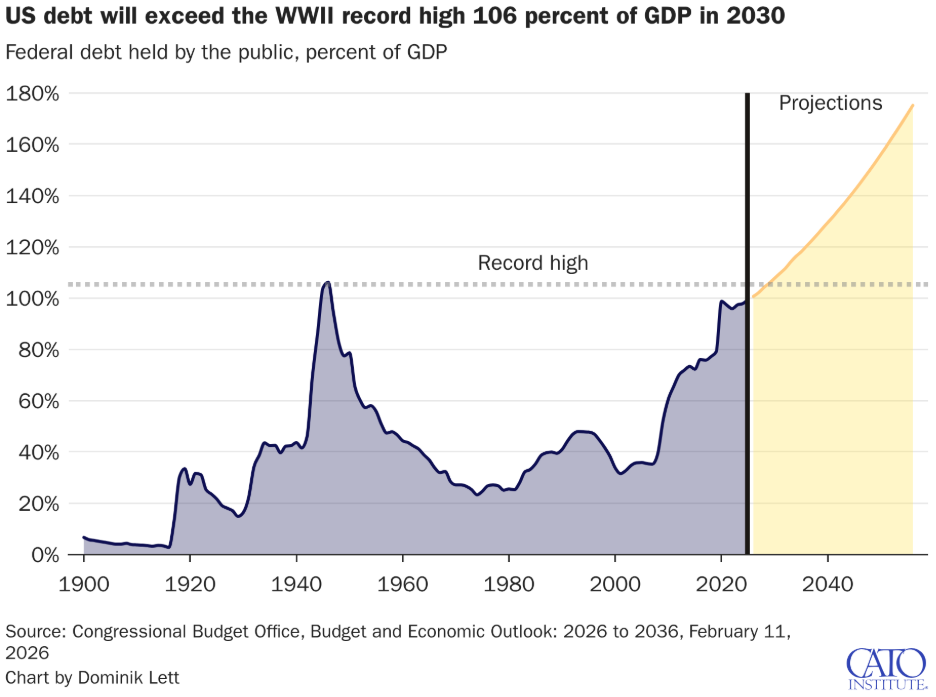
The Congressional Budget Office’s (CBO) latest Budget and Economic Outlook shows that debt held by the public exceeds 100 percent of GDP this year and will rise above its World War II record by 2030. Ten years from now, debt will be roughly 120 percent of GDP and will continue to climb to 175 percent by 2056 — and that is under optimistic projections that assume no economic, financial, or public health crises over that time.


Revenues are not the problem. Even after extending and adding to the Trump tax cuts, federal receipts are projected to remain near or above their historical average as a share of the economy, growing from $5.2 trillion (17.2 percent of GDP) to $8.3 trillion (17.8 percent of GDP) over the decade.

The problem is that federal spending exceeds revenues by a lot and is growing much faster than revenues. Spending is projected to grow from $7 trillion (23.1 percent of GDP) to $11.4 trillion (24.4 percent of GDP). 

The widening annual deficit (the gap between annual spending and revenue) is overwhelmingly driven by the growth in Social Security, Medicare, Medicaid, and rising interest costs. By 2036, interest costs, Social Security, Medicare, and Medicaid are projected to consume 100 percent of federal revenues.

Read that again.

Under current law, within a decade, every dollar collected in revenue will be absorbed by health care programs, Social Security, and interest spending to service the ballooning federal debt, leaving nothing for national defense or any other core function of government.

Multiple estimates, from the Congressional Budget Office, the Yale Budget Lab, the Penn Wharton Budget Model, and the Tax Foundation, estimate that the Trump tariffs would generate from $1 trillion to $3 trillion in additional revenue over a decade, depending on assumptions and whether economic feedback effects are included.

Those are large numbers in isolation. But they are small relative to the size of the federal budget hole.

CBO projects that the United States will borrow an additional $25 trillion over the next decade. Closing that gap would require eight to 25 times the revenues that Trump administration tariffs were estimated to bring in. About $16 trillion of those deficits will go toward interest payments alone. Even under optimistic assumptions, tariff revenue would offset only a small fraction of that amount.

Put differently: even if every dollar of projected tariff revenue materialized, the debt would still surge past its historic high within a few years and continue unsustainably climbing thereafter.

Moreover, tariffs are neither free money nor are they paid by foreign exporters. They function as taxes on imported goods and production inputs that are paid by Americans. According to the Kiel Institute, American consumers and importers paid 96 percent of tariff costs, while foreign exporters absorbed only four percent. Higher input costs reduce business profits and workers’ wages, shrinking corporate and individual income tax collections. From generating uncertainty to reducing available capital for investment, tariffs reduce hiring and dampen economic growth.


Part of the “revenue gain” from tariffs is thus clawed back through weaker economic performance and a smaller tax base. That’s one way to shoot yourself in the foot.

Meanwhile, the real driver of America’s debt trajectory is far more entrenched.

The entirety, more than 100 percent, of the federal government’s long-term funding shortfall stems from the growth of Social Security and Medicare, according to the Financial Report of the United States Government. These programs expand automatically as the population ages, beneficiaries live longer, benefits increase by design, and health costs rise. They were set up for a younger country with far fewer retirees per worker and transfer income from working Americans to retirees, regardless of need. One of the best ways to curb their growth is to refocus these programs’ benefits on seniors in need.

As debt climbs, interest costs compound. CBO projects that net interest will more than double over the next decade, consuming a growing share of the budget.

Interest costs already surpass what the United States government allocates toward national defense expenditures. As the Hoover Institution’s Niall Ferguson writes: “When a great power spends more on debt service than on defense, it will not be great for much longer.” The US Senate unanimously recognized  deficits as “unsustainable, irresponsible, and dangerous,” as if they were innocent bystanders. But Congress has yet to act to curb the debt threat.

This is how fiscal crises develop — not because a single revenue stream disappears, but because structural commitments grow faster than the economy that must finance them.

The United States is already well above the debt levels that much of the economic literature associates with slower long-term growth. Every year of delay increases the eventual adjustment required to stabilize the debt.

Congress should adopt a credible plan that stabilizes spending and the growth in debt. Members of the bipartisan fiscal forum in Congress recently proposed a three-percent-of-GDP deficit target, led by Representatives Bill Huizenga (R-MI), Scott Peters (D-CA), Lloyd Smucker (R-PA) and Mike Quigley (D-IL). That’s a promising goal. To succeed in meeting it, Congress will need structural entitlement reforms. Not killing the goose that lays the golden eggs with economy-crushing tax hikes — whether those are dressed up as tariffs or as a border adjustment tax.

Congress can reduce excess health care spending, streamline taxes, and cut welfare programs prone to fraud and abuse, using the same reconciliation process that Republicans leveraged in July to extend and expand the Trump tax cuts and slow the growth in Medicaid and food stamps (SNAP).

Going yet further, Congress can work toward advancing a Base Realignment and Closure–style fiscal commission to overcome policy inertia and provide Congress with political cover to advance necessary entitlement reforms. The Fiscal Commission Act, championed by Representatives Scott Peters (D-CA) and Bill Huizenga (R-MI) is a promising step in that direction.

If America ever experiences fiscal “ruin,” it will not be because presidential tariff authority was constrained. It will be because elected officials of both parties failed to modernize the country’s largest entitlement programs and halt their automatic spending growth.

The Supreme Court’s ruling does not create a fiscal crisis. Tariffs raised revenue at the margin. In the process, they also distort trade and slow growth. But they do not alter the fundamental arithmetic driving America’s debt.

The path to fiscal stability runs through entitlement reform and spending control — not through executive-imposed tariffs that were never large enough to solve the problem in the first place. (much from Reason)

Wednesday, February 12, 2025

A Minority Debt Report


Comedian John Mulaney has a routine:   there’s a horse loose in the hospital . . . !!


***

Some Disney insiders worry that the company has become addicted to price hikes and has reached the limits of what middle-class Americans can afford, reports Robbie Whelan.

***

Sierra Bille has received $350,00 so far in scholarships and financial aid to attend New York University. The 24-year-old Las Vegas native applied to dozens of assistance programs to afford her longtime dream school, whose published cost for 2022-23 topped $82,000, including housing and living expenses.

***


A Minority Debt Report

I don't know where I found this but what is astonishing is that this view is considered a philosophy.

The Federal Reserve has tools to keep interest rates falling, including buying Treasury bonds from its member banks. This drives borrowing costs down. After the 2008 financial crisis, the Fed used tools like these to hold 10-year interest rates around 2 percent for more than a decade, despite a growing national debt. Why assume that such policies won’t work in the future?

Of the $35 trillion in U.S. national debt, only about $8-9 trillion is held by foreign countries. China, the debt hawk’s No. 1 boogeyman, holds only $816 billion or 2.3 percent of this $35 trillion. The rest — roughly $25 trillion — is held domestically by U.S. government agencies like the Social Security Trust Fund and military retirement funds, as well as private corporations. Foreign and domestic holders earn interest on their holdings, so the debt is a paying investment for them. For China and others, holding dollars also keeps their currencies cheap so they can export more.

Instead of obsessing over a government debt crisis that may never happen, it makes more sense to borrow and spend money to mobilize our immense resources to deal with immediate problems, as we did in World War II. The U.S. needs to support stressed working and middle-class families, respond to dangerous conflicts in the Middle East and Ukraine, counter China’s growing global influence, and manage the transition to cleaner energy and the rise of artificial intelligence.

This argument avoids the basic question of debt: can the cost of it be maintained without pain? Debt can be productive, as borrowing for seed for a crop. But often debt is malignant and a good signal is when money must be borrowed to maintain it.

Thursday, September 19, 2024

Social-Welfare Spending


Democracy is the theory that the common people know what they want, and deserve to get it good and hard.--Mencken

***

About 9% of converts to Islam in the U.S. are Latino nationwide according to a 2020 survey, an increase from 5% in 2017. The majority are women.
Spanish converts to Islam have increased by a factor of 10 in the last 30 years.

***


Social-Welfare Spending

Ask any budget expert in Washington to explain the ballooning deficit and debt, and Social Security and Medicare will be high on the list of causes. That’s wrong. The real driver, the elephant in the room, is means-tested social-welfare spending—Medicaid, food stamps, refundable tax credits, Supplemental Security Income, Temporary Assistance for Needy Families, federal housing subsidies and almost 100 other programs whose eligibility is limited to those below an income threshold.

True, Social Security and Medicare are a drain on general revenue and will become big fiscal problems if not reformed. But they aren’t the major source of our current fiscal crisis, because both are financed largely by dedicated payroll taxes. Since its inception, Social Security has produced cash surpluses 60% of the time. In 2023 Social Security payroll taxes funded 88.9% of benefits. The cost of Social Security’s Old-Age, Survivors and Disability Insurance program, net of payroll tax collections, was only $88.1 billion. Medicare payroll taxes and premiums funded 49.7% of Medicare expenditures, producing a net cost of $509 billion.

Demand for reform would be even stronger if the public understood how generous social-welfare benefits are. In reporting household income, the Census Bureau doesn’t count 88% of transfer payments made to households that are defined as being poor. The census doesn’t count refundable tax credits (for which the beneficiary receives a check from the Treasury), food-stamp debit cards, free medical care through Medicaid, or benefits from about 100 other federal transfer payments as income to welfare recipients. When those benefits are counted as income, 80% of those who are today counted as being poor are no longer poor, and almost half have incomes equivalent to American middle-income earners.--wsj

Monday, May 20, 2024

Stop or be Stopped

The founder of the Slovakian group “Against Violence" just shot the country’s prime minister.

***

Markets everywhere emerge in an unplanned, spontaneous way, adapting to local traditions and circumstances, and not through reforms designed by outsiders. The free market depends on the bottom-up emergence of complex institutions and social norms that are difficult for outsiders to understand, much less change.--Easterly

***

Judge Merchan made nominal contributions to the 2020 United States presidential election, donating $15 to Joe Biden's campaign, $10 to the "Progressive Turnout Project," and $10 to "Stop Republicans." What does that mean? Why would he make such small contributions at all?

***


Stop or be Stopped

America is on what Federal Reserve Chairman Jerome Powell calls “an unsustainable fiscal path.” 'Unsustainable' means 'stop or be stopped.'

Well into the business cycle, we are pumping fiscal stimulus equal to an unprecedented 6% of GDP and a quarter of all government spending into the economy, with no end in sight. Federal debt has risen from 70% of GDP after the financial crisis to nearly 100% today, following $5 trillion of pandemic spending to close what was likely a $1 trillion shortfall.

Tax revenues as a share of GDP are projected to remain above their 50-year average, but spending has grown to a historically high 23% of GDP from 19% before the financial crisis. Only half that increase is driven by retiring baby boomers, whose growth is expected to increase spending by another 2% of GDP over 10 years. And, importantly, government spending does not seem to be subject to reflection or analysis.

A political resolution doesn’t seem likely. Retirees seem intent on keeping what was promised them and avoiding benefit cuts. Policymakers are unlikely to raise middle-class taxes—they are engineering cuts by expanding the child tax credit. Heavy tax increases on the highest earners are estimated to contribute less than 2% of GDP.

The only answer here is economic growth--serious growth in a pro-growth economic and political atmosphere--and restrained spending, qualities absent in most political toolkits. And such policies are impossible among those hoarders of outmoded, confiscatory, redistributing (and hostile) weak-minded philosophies periodically exhumed from ancient European graveyards.

Wednesday, February 14, 2024

A Canary is Silent But the Fat Lady Sings


Former Ohio State quarterback Art Schlichter was arrested Friday in Columbus after a state trooper found cocaine in his car, according to court records.

***

Zoom fatigue is real! When people talk face-to-face, they respond to yes-or-no questions in 297 milliseconds, on average, but this number jumps to 976 milliseconds when talking over Zoom. This imperceptible delay interferes with the neural mechanisms that govern the normal back-and-forth of human conversation, and the body’s physiological response is fatigue.

***


A robotic lunar lander is scheduled to launch in the early morning hours of Wednesday. If all goes well, it will become the first American spacecraft to set down softly on the moon’s surface since the Apollo 17 moon landing in 1972.
It is also the latest private effort to send spacecraft to the moon. Earlier attempts have all ended in failure. But the company in charge of the latest effort is Intuitive Machines of Houston.

***


A Canary is Silent But the Fat Lady Sings

Congressional Budget Office published its annual 10-year Budget and Economic Outlook. In a country that thinks its border is 'secure,' such information will likely be ignored. 

But...according to the CBO’s latest estimates, in 2024 the U.S. government will pass a grim and once-unimaginable milestone. The federal debt has gotten so large that spending on interest to service that debt will exceed federal spending on national defense.

In the CBO’s long-term projections, interest payments will become the largest line item in the budget—exceeding even spending on federal health care programs—sometime in the 2040s. It’s very likely that sometime between now and then, global financial markets sour on U.S. Treasury bonds as a sound investment, leading to an unprecedented and dangerous economic crisis with rising interest rates, higher inflation, and social turmoil.

Federal Interest Costs Now Exceed U.S. Defense Spending

(Estimated $ billions, 2022–2034)

Net Interest (2024 projection)

Defense (2024 projection)

2034203320322031203020292028202720262025202420232022$1,000$900$800$700$600$500$400$1,700$1,600$1,500$1,400$1,300$1,200$1,100$659$659$870$870$951$951$1,005$1,005$1,049$1,049$1,105$1,105$1,170$1,170$1,241$1,241$1,328$1,328$1,430$1,430$1,527$1,527$1,628$1,628$891$891$871$871$892$892$912$912$933$933$954$954$976$976$998$998$1,021$1,021$1,045$1,045Departure from dollar-gold peg, August 1971

Wednesday, January 24, 2024

MMT


I see the abortion issue is back.

***

Joe Torrey was a Braves' broadcaster for 16 years before becoming the Yankee's manager.

***

93 of the top viewed TV broadcasts last year were NFL broadcasts

***


MMT

Jonathan Miltimore is the Managing Editor of FEE.org and a Senior Writer at AIER and recently wrote an article on the American growing debt and the strange reactions to it. This is from it.

"NPR’s Leila Fadel asked Stephanie Kelton, a professor of economics at Stony Brook University, if Americans should “be afraid” of this mountain of red ink.

“No. They shouldn’t,” Kelton responded. “It’s the word debt that makes people afraid. And so when I think about this, you know, I look at this number, and I think, well, it’s just keeping track of our savings.”

The idea that debt is just “keeping track of our savings” is peculiar. But Kelton is a peddler of strange ideas.

For those who don’t know, Kelton, an advisor to Bernie Sanders during his 2016 presidential run, is a disciple of Modern Monetary Theory (MMT), a school of economics typically rejected (and often laughed at) by other economists.

MMT is distinguished from other economic schools of thought in that it posits that governments that issue fiat money don’t actually need to collect taxes to pay for their goods and services. As the New York Times stated in a 2022 profile of Kelton, “How will you pay for it?” is considered “a vapid policy question” in the MMT world. Things like budgeting are for cavemen.

In case you think I’m exaggerating, I’ll quote Kelton directly.

“[T]he idea that taxes pay for what the government spends is pure fantasy,” she writes in The Deficit Myth. “[I]t is the currency issuer — the federal government itself — not the taxpayer, that finances all government expenditures.”

Since the state can simply print money, its only real financial constraint is inflation, MMT proponents argue. This is, of course, true in a sense. Governments can print as much money as they want, but there is nothing profound or “modern” about this revelation.
‘The Carpenter Can’t Run Out of Inches’

China’s Song dynasty introduced paper money way back in the 10th century. Paper notes were convenient, and all went well initially because the notes were at first backed by coins made of precious metals. Things went south, however, when Chinese officials began printing notes that weren’t backed by coins. Hyperinflation ensued, and Song China was soon swallowed by the Mongol Empire.

History is replete with similar examples, most recently in Argentina, where Peronists for years tried to solve its social problems by printing money.

Inflation is a curse. And MMT is a recipe for hyperinflation, as Harvard economist and former Clinton Treasury Secretary Lawrence Summers has noted, along with countless other economists.

The economics of this are not complex. Every economist knows there’s no such thing as a free lunch. Printing mass amounts of money cannot solve the problem of scarcity. This fundamental economic reality, that we have limited resources and limitless wants, seems lost on Kelton.

“The carpenter can’t run out of inches,” she tweeted in 2019. “The stadium can’t run out of points. The airline can’t run out of [frequent flier] miles. And the USA can’t run out of dollars.”

Kelton’s tweet reflects a fundamental misunderstanding of scarcity.

A carpenter might not be able to run out of inches, but he can run out of lumber and nails. Airlines might not be able to run out of frequent flier miles, but they can run out of seats and fuel, something better economists than Kelton have pointed out.
The ‘Court Intellectuals’

This brings me back to NPR.

It’s unclear why the media network chose to interview an economist with such discredited views to explain away the country’s mountain of debt. Whatever some may think, public debt is no laughing matter. Thomas Jefferson once described it as “the greatest of the dangers to be feared” for any country.

It seems unlikely that NPR wouldn’t know Kelton’s views on debt, which is to say they would know exactly how she’d answer their questions as to whether $34 trillion in federal debt is a problem. But then why have her on? A cynic might suggest that it stems from the fact that NPR receives 10 percent of its funding from government entities, all of which benefit from the government’s inflationary policies.

NPR would no doubt bristle at such an accusation. After all, the media network quit Twitter after Elon Musk branded the company “state-affiliated media.”

Many took issue with Musk’s label, but there is indeed something deeply troubling about government-funded media. Americans laugh at the clumsy propaganda organs of other countries, but many grow indignant at the suggestion that the government shoveling tens of millions of dollars to NPR could influence its media coverage.

Perhaps NPR’s government largesse is indeed the product of altruism. But there’s another possibility.

The economist Murray Rothbard, who spent a better part of a lifetime analyzing the state, had a dark theory on why the state takes interest in intellectuals like Kelton and media organizations like NPR.

Rothbard understood that the source of political power (“might,” as the economist Ludwig von Mises said) is ideology. Therefore, those who seek to maintain power have an incentive to shape ideas, opinions, and thoughts. And Rothbard argued that a primary purpose of the modern nation-state involved opinion-molding — essentially convincing the masses that its existence was valid, necessary, moral, and useful.

This is where Kelton comes in.

Rothbard wrote:

Since its rule is exploitative and parasitic, the State must purchase the alliance of a group of ‘Court Intellectuals,’ whose task is to bamboozle the public into accepting and celebrating the rule of its particular State. In exchange for their continuing work of apologetics and bamboozlement, the Court Intellectuals win their place as junior partners in the power, prestige, and loot extracted by the State apparatus from the deluded public.

Kelton (and to a lesser extent Fadel) are what Rothbard would describe as Court Intellectuals, tools of the state’s opinion-making machine.

This is not to say that NPR doesn’t do any good journalism. I believe it often does. But it helps explain why NPR tapped Kelton, an economist with bankrupt ideas, for its piece on America’s $34 trillion debt, instead of any number of credible economists.

Kelton was all but certain to say the $34 trillion debt was no problem. Don Boudreaux, Peter St. Onge, David Henderson, Bob Murphy, Antony Davies, or any number of other free-market economists would have given a very different answer, one that no doubt would have been far more grounded in economic reality. But as a media entity receiving tax dollars, NPR has little incentive to promote a free-market economist or free-market views. Indeed, they have an incentive to do precisely the opposite.

Regardless of what NPR told its viewers, the $34 trillion national debt is a serious problem, not a mark of government “savings.”

And we know the primary cause of the problem.

“Washington has been spending money as if we had unlimited resources,” Sung Won Sohn told the Associated Press.

Our leaders in Washington, it seems, suffer from the same delusion as Kelton."

Something so whimsical--and non-academic--is hard to explain in this culture. Unless, of course, you look at 64 genders, borderless security, unlimited access to illegal, fatal drugs, and individuals responsible for abstract group acts and abstract groups responsible for individual acts.

We have become a culture of notions.