Showing posts with label economics. Show all posts

Monday, June 22, 2026

Truth Inequity


On this day:
1633
The Holy Office in Rome forces Galileo Galilei to recant his view that the Sun, not the Earth, is the center of the Universe.
1848
Beginning of the June Days Uprising in Paris, France.
1898
Spanish–American War: United States Marines land in Cuba.
1941
Germany invades the Soviet Union in Operation Barbarossa.
1944
U.S. President Franklin D. Roosevelt signs into law the Servicemen’s Readjustment Act of 1944, commonly known as the G.I. Bill.
1945
World War II: The Battle of Okinawa ends when the organized resistance of Imperial Japanese Army forces collapses in the Mabuni area on the southern tip of the main island.

***

    If the Democrats came up with a plan for all Americans to jump off a thousand-foot cliff tomorrow, some Republicans would come up with an 'alternative’ plan in which we would all jump off a 500-foot cliff next week.--Sowell

    ***

    U.K. Prime Minister Keir Starmer announced Monday that he will stand down as Labour leader and prime minister, ending months of political turmoil and opening a contest to replace him.

    ***
  • In 2024, the academic journal Nature Human Behavior (NHB) published a study that claimed anti-transgender laws increased suicide attempts among young people by 72 percent. The media touted the findings as evidence that Republican-led laws are creating an epidemic of self-harm among youth, while the study authors promoted the research as a cause-and-effect narrative.

    Now, the study is crumbling under reexamination. A criticism published in the NHB last month shows that the research was pulled from a small sample in Idaho, and at a time when the state’s “anti-transgender” laws weren’t even in effect.
  • ***

    McCarthy in NR on Trump and Iran:

    A close second on the ridiculous meter is the insistence by Trump and Vice President Vance that Iran will not be getting a dime of U.S. taxpayer money. That’s a straw man. The point is that Iran gets access to funds — through sanctions relief and whatever cockamamie “investment fund” the administration is conjuring. That the funds are not coming directly out of the U.S. treasury is beside the point.
    The most ridiculous nonsense (admittedly, there’s a lot of competition here) is that Iran has foresworn nuclear weapons. Iran has always publicly foresworn nuclear weapons and emphasized that it is a member of the Nuclear Non-Proliferation Treaty (NPT). That is what NPT members who aspire to nuclear weapons do. And as I recounted yesterday, just to make bigger fools out of us, Iran has also maintained that Ayatollah Khamenei even issued a fatwa against nukes (Khamenei was not qualified to issue fatwas, there wasn’t one in any event, and the regime zealously went about its nuclear weapons program even as it publicly claimed it neither wanted nor needed them). To see the president beating his chest that “Iran has agreed to never have a Nuclear Weapon!” is really quite something.

    ***

    Conservatives rightly blasted the use of sue-and-settle tactics employed by progressive groups during the Obama administration. Instead of fighting lawsuits brought by environmentalists, for example, the Environmental Protection Agency would enter into settlements that gave it what it wanted. The goal was to use the illusion of an adversarial legal process to lock in progressive policy wins without formal rulemaking that couldn’t pass muster or legislation that couldn’t pass either chamber.--WSJ

    ***

    Mother Jones has an article on why there is no real Social Security crisis. It is breathtakingly shallow.

    ***


Truth Inequity

An essay by Astra Taylor in the New York Times opens with this sentence:  “Since 2020, the richest 1 percent has captured nearly two-thirds of all new wealth globally — almost twice as much money as the rest of the world’s population”

Nobel-laureate emeritus, Vernon Smith, composed this insightful response:  

"The opening sentence implies that wealth is produced independently of human action, which is devoted mainly to capturing it. If that is your understanding of the world, you can only feel insecure, fear it, and write of your terror.

And what does it reveal about the NYTimes that it wallows and champions this perspective? A truly dedicated mission to spread gloom and unhappiness. It is one thing to report bad news, it’s another to glory in it."

Envy is making a good run at mendacity as the nation's defining quality. Here it masquerades as economic theory. There's a charming Old World quality about income disparity where, like the Third World, there is a huge spread between people with everything versus those with nothing. But warlords, demagogues,  and divine right are not economic theories any more than a highwayman is a traffic cop. These are simple suppression and theft. 

And, somehow, this all correlates with a guy driving an F-150 not having a Dreamliner.

Wednesday, March 18, 2026

Civility


On this day:
37
The Roman Senate annuls Tiberius’s will and proclaims Caligula emperor.
235
Emperor Alexander Severus and his mother Julia Mamaea are murdered by legionaries near Moguntiacum (modern Mainz). The Severan dynasty ends.
1229
Frederick II, Holy Roman Emperor declares himself King of Jerusalem during the Sixth Crusade.
1241
Mongols overwhelm Polish armies in Kraków in the Battle of Chmielnik and plunder the city.
1314
Jacques de Molay, the 23rd and the last Grand Master of the Knights Templar, is burned at the stake.
1834
Six farm labourers from Tolpuddle, Dorset, England are sentenced to be transported to Australia for forming a trade union.
1871
Declaration of the Paris Commune; President of the French Republic, Adolphe Thiers, orders evacuation of Paris.
1915
World War I: Massive naval attack in Battle of Gallipoli. Three battleships are sunk during a failed British and French naval attack on the Dardanelles.
1922
In India, Mohandas Gandhi is sentenced to six years in prison for civil disobedience. He would serve only 2 years.
1942
The War Relocation Authority is established in the United States to take Japanese Americans into custody.
1962
The Evian Accords put an end to the Algerian War of Independence, which began in 1954.
1965
Cosmonaut Aleksei Leonov, leaving his spacecraft Voskhod 2 for 12 minutes, becomes the first person to walk in space.
1968
Gold standard: The U.S. Congress repeals the requirement for a gold reserve to back US currency.
1990
In the largest art theft in US history, 12 paintings, collectively worth around $300 million, are stolen from the Isabella Stewart Gardner Museum in Boston, Massachusetts.

***

What is especially disturbing about the political left is that they seem to have no sense of the tragedy of the human condition. Instead, they tend to see the problems of the world as due to other people not being as wise or as noble as themselves.--Sowell

***

We are asked to suffer at TSA by politicians for a greater cause they cannot articulate. When will they ask us for the sacrifices necessary to offset the problems of the national debt they created?

***

This is an ad for AI DJs. If this is true, it is amazing.

https://www.youtube.com/watch?v=reR71FQExxo

***

Joe Kent, the director of the National Counterterrorism Center, resigned on Tuesday. He wrote about his wife in his resignation letter. She was an NSA linguist killed in Syria.

On Jan. 16, 2019, Chief Kent was meeting with a source at a restaurant in Manbij, Syria, when a suicide bomber killed her and three other Americans.

Chief Kent was posthumously promoted to senior chief.

“She should have been out of Syria because Trump gave the order to get those guys out of there,” Mr. Kent said on the “Shawn Ryan Show” podcast. “And then you have the administrative state dragging their heels and desperately trying to keep us in these conflicts.”

In his resignation letter, Mr. Kent cited what he said was Israel’s influence over the Trump administration’s policies.

***

From an article on Cesar Chavez:
"Insiders hinted the explosive allegations — the details of which have yet to be released — had been been a long time coming."

***

Your government at work.

On this day in 1937, a massive explosion caused the steel-framed school building in New London, in Rusk County, to collapse, killing a reported 298 people. It was the worst school disaster in United States history.
Of the 500 students in the building, only about 130 escaped serious injury. The explosion, which was heard four miles away, occurred when a manual-arts teacher turned on a sanding machine and inadvertently ignited a mixture of gas and air.
Three days after the explosion, inquiries were held to determine the cause of the disaster. Investigators learned that in January 1937, to save gas expenses of $300 a month, the school board and superintendent had authorized plumbers to tap a residue gas line of H. L. Hunt's Parade Gasoline Company. Apparently, gas had escaped from a faulty connection and accumulated beneath the building.


***


Civility


Imagine you patronize a local grocery where you notice the butcher regularly puts a finger on the scale. He distorts your purchase. And your relationship.

Trade is more than an exchange of goods. It goes beyond social conviviality. It creates — and is the result of — trust. It makes fair exchange possible, which ordinarily entails the risk of loss. That trust is built and reinforced over time, trade after trade, so that basic principles of fairness under mutually agreed-upon rules become assumed and expected. They don't have to be negotiated and renegotiated in an atmosphere of suspicion. A good relationship has developed through predictable honesty, and the trade is mutually beneficial. The trade is shared. And that fairness spreads.

Trade is not just civilized, it is civilizing.

Now, apply these observations to tariffs.....


Wednesday, May 7, 2025

Deficits

On this day:
1429
Joan of Arc ends the Siege of Orléans, pulling an arrow from her own shoulder and returning, wounded, to lead the final charge. The victory marks a turning point in the Hundred Years’ War
1794
French Revolution: Robespierre introduces the Cult of the Supreme Being in the National Convention as the new state religion of the French First Republic.
1915
World War I: German submarine SMU U-20 sinks RMS Lusitania, killing 1,198 people including 128 Americans. Public reaction to the sinking turns many formerly pro-Germans in the United States against the German Empire.
1942
During the Battle of the Coral Sea, United States Navy aircraft carrier aircraft attack and sink the Japanese Imperial Navy light aircraft carrier Shōhō. The battle marks the first time in the naval history that two enemy fleets fight without visual contact between warring ships.
1945
World War II: General Alfred Jodl signs unconditional surrender terms at Reims, France, ending Germany’s participation in the war. The document takes effect the next day.

***

I am weary of the provocateur-in-chief.

***

ESPN is reporting that Pickens has been traded

***

The basic problem in the Middle East is the Nuclear Suicide Bomber, a nation willing to blow up the world because of its vision of the will of God. That risk has always been concentrated on Israel and its enemies. But this India-Pakistan fight has similar nihilistic potential. We see microcosms of it every day: morons with weapons.

***

The fight between the teen gang and the police in Times Square had a very São Paulo, Brazil feel. Very diverse and international.

***


Deficits

Free trade occurring without government management or interference had been a hallmark of American economics. Think of all those niggling trade bills the British used against New Englanders before the Revolution. Well, they're back.

Does Pennsylvania have a trade deficit with Alaska? California? Do you have a trade deficit with your dentist?

A nation indeed has more in play than simple numbers. But it is also true that some of the number debates are simply untrue.

There’s little obvious connection between the U.S. trade balance and economic output (gross domestic product). This chart from a recent Cato essay on the trade balance shows that the relationship between higher trade surpluses (or smaller deficits) and higher GDP growth is practically nonexistent, although I can't copy it well. 
(Much from Scott Lincicome)
If that hypothesis were correct, these two series would be rising and falling in concert.

One can’t judge whether a trade deficit is a problem without considering its underlying macroeconomic causes and how related foreign capital inflows are used. If those inflows are caused by a nation’s young population and its attractiveness as an investment destination—and if they’re invested productively in things like education, housing, or research—then the resulting trade deficit would be benign. If, on the other hand, the trade deficit is primarily driven by an elderly citizenry’s debt-financed consumption and by profligate government spending, then it could be more of a concern. 
In either case, however, the trade deficit remains a symptom, not a cause, of a nation’s underlying economic issues.

Aside from our government’s runaway deficit spending, none of the drivers of the U.S. trade deficit is necessarily “bad” for the U.S. economy, and many of them—portfolio investment, foreign direct investment, etc.—are objectively good and indicative of a thriving economy. (U.S. household debt is mostly home mortgages and has actually been trending down since the mid-2000s, while corporate debt has been basically flat for decades.)

This also explains why no serious economist thinks tariffs or trade deals will significantly reduce, let alone eliminate, the U.S. trade deficit. Tariffs can reduce both imports and exports, reducing a nation’s overall level of trade but leaving its trade balance unchanged in the long run”—a conclusion supported by research on dozens of different countries and the United States’ experience during the first Trump term.

Even imported consumer goods can boost U.S. output. Companies tasked with moving or selling imported items—in wholesale trade, retail trade, and transportation and warehousing —generate trillions of dollars of additional U.S. economic output. By reducing retail prices, moreover, imports can free consumer dollars for spending on American goods and services. And, as already noted, dollars spent on imports quickly return to the United States as either investment in U.S. assets or purchases of exports, both of which contribute to economic growth.

It’s similarly wrong to assert—as our president often does—that the U.S. trade deficit represents a loss of wealth for the United States or some kind of national “debt.” For starters, this ignores that dollars we send abroad to foreigners buy us real goods and services that we value (or else we wouldn’t buy them), and that—as discussed above— those same dollars eventually return to the United States as investment in the U.S. private or public sector (by mostly unrelated people). Some call the latter a “debt” we Americans must repay, but in many cases—portfolio investment, foreign direct investment, real estate, and basically anything else that isn’t actual public debt—that’s not really true. Corporate debt, for example, is owed by shareholders and employees of the company at issue, not by you and me. Foreign purchases of equity (stocks), property, or even entire U.S. companies isn’t “debt” at all—and can benefit most Americans and the nation if the investment spurs more hiring/production/innovation, causes stocks to rise, or causes similar, American-owned assets (e.g. property) to appreciate too. It’s not zero-sum. 
So Japanese investment in U.S. Steel is seen, on the accounting ledger, as a negative balance of trade and some sort of risk despite being obviously beneficial.

Another huge and common mistake is using bilateral trade balances—e.g. the U.S. trade deficit with China—as indicative of economic problems or as some sort of trade policy scorecard.  

Most basically, the world has more than two countries, so—just as my trade deficit with my grocery store tells us almost nothing about my overall financial position—a U.S. trade deficit with, say, Mexico tells us almost nothing about our own economy. 

A country's integrity might well be threatened by trade. Relying on your sworn enemy for your energy or bullets is a bad long-term plan. But historically, we have actually encouraged these imbalances. We suppress our own energy production in favor of that of Russia and the Middle East, certainly cultural unfriendlies. That is--or has been until now--purposeful. It was a hallmark of what passes as the Biden administration. 
It is certainly worth discussion, but a cynic might say that leadership does not understand the factors or doesn't think the citizenry capable of the debate. 

Both of those scenarios are a lot worse for the nation than trade deficits. 

Thursday, January 2, 2025

Americans and Europe

Re the attacks in New Orleans and Las Vegas: 
Messianic causes, religious or political, demand engagement. It should be clear that no culture can be safe from them. The idea that the U.S. specifically or the West generally can simply disengage and walk away from the Middle East or Russia is naive.
   --The FBI's first instinct (their first announcement from Ms. Duncan declared the attack 'was not terrorism') is to manage public opinion. Truth does not seem ever to be a priority.
   --60% of radical Islamic online social media presence is from North Africa.
   --Messianic causes are programmed to engage, regardless of their victims' nature. That is why they are so comfortable attacking schools, hospitals, and nunneries. They are robotically aggressive. They will not stop.

***

Argentina’s deregulation czar, Federico Sturzenegger has discovered a rough rule of thumb: Where deregulation happens, prices decline in the range of 30%. He has seen it in textiles, logistics, and some agricultural products.
30% is a decade of 3% extra growth.

***

One in eight individuals will end up in the top 1% of U.S. income earners at least once in their lifetimes; only 1 in 166 will remain there for a decade.

***


Americans and Europe

The Americans are deeply criticized by a loud, intense, European minority. Some are simple foreign agents on a relentless, insincere social media crusade, some are fanatical faith-based social zealots, and many are mean, jealous outsiders with a nationalist bias. Here is a clarifying little snippet that is informative:

'While Europe has created 14 companies worth more than $10 billion in the past 50 years, with about $400 billion of market value in total, Americans have created nearly 250 such companies, worth $30 trillion.

That success has driven up America’s middle-class incomes. The median disposable U.S. household income, according to the OECD, is now 25% greater than the median German household and 60% greater than the median household in Italy.

Europeans’ incomes would be even lower if they weren’t free-riding on American innovation, defense spending, and higher drug prices, which incentivize research. America’s median incomes would be higher if we had more talent devoted to supervising and creating jobs for blue-collar workers or Northern Europe-like distribution of test scores.

The outsize success of America’s talented entrepreneurs doesn’t stem from their superior intelligence. It comes from working at companies such as Google and Microsoft, which mine the technological frontier and expose employees to valuable knowledge, insights, and opportunities. Apple is worth more than the 30 largest German companies combined. Apple’s employees and its alumni use their knowledge and training to create more value than their counterparts in Europe.

Unlike Europe, the enormous success of American entrepreneurs motivated an army of talented Americans to get valuable on-the-job training, work longer hours, take risks, and succeed. A small amount of success bubbles up from a large pool of failure.

…..

When entrepreneurs capture as little as 5% of the value they create for others, it makes little sense to encourage successful risk-takers to quit working long before they achieve outsize success. With the effect technological success has on the productivity of talented American workers, who are our constraint to growth, and the effect of their productivity on the growth of middle-class incomes relative to Europe, that’s not a “policy failure.”'--Conard

There are myriad additional factors involved with the distinctions here. Many are outlined by the insightful McClosky. Another is the failure of Americans to indulge in vindictive, self-destructive tax policies. However the major one is an old De Tocqueville observation: Americans regard success highly and do not see the success of others as an impediment to their own individual efforts to attain similar success.

Thursday, December 12, 2024

Diversity of Outcomes

An 11-year-old girl was rescued after three days of being stranded at sea when a shipwreck off Italy's Lampedusa island is believed to have killed the remaining passengers on the vessel.
There were an estimated 45 passengers onboard the ship before it sank.
She survived without any drinking water or food and despite suffering from hypothermia, she was "responsive and oriented," according to the release.

***

President Joe Biden is commuting the sentences of roughly 1,500 people who were released from prison and placed on home confinement during the coronavirus pandemic and is pardoning 39 Americans convicted of nonviolent crimes. It’s the largest single-day act of clemency in modern history.

***

“Violence is never the answer. But people can only be pushed so far.”--Elizabeth Warren on murdering a CEO
So violence sometimes is the answer?

***


Diversity of Outcomes

Inequality is all the rage. It is essentially "differences" in the culture. Its production. Its efforts. Its qualities. In the West, these differences, combined with liberty, have allowed for an astounding, diffuse economic advance across all groups, some more than others. But all have benefitted beyond all historical norms or expectations. Yet, despite this extraordinary achievement, some emphasize the unequal allocation of success.

Segments of a book review by James Hartley:

"Limitarianism: The Case Against Extreme Wealth by Ingrid Robeyns is a very bad book. Writing a review of it thus presents a challenge. Who wants to read a review that is the equivalent of shooting fish in a barrel of dead fish? Yet, while reading Robeyns’ tendentious screed, I was faced with the absolute certainty that quite a few of my colleagues and students would love this book.

…..

As I said at the outset, writing an entire review just documenting how bad this book is would be an incredibly easy task. Pick a page at random, and you’ll find multiple examples of an argument neither cohesive nor persuasive. The question is: how is it possible that the book is this bad? The answer is found in the Introduction. On the third page, Robeyns notes, “For a long time, I felt that there was something wrong with an individual amassing so much money, but I couldn’t properly articulate why.” So, she “decided to deploy my training in philosophy and economics to answer the question: Can a person be too rich?” The arguments in this book did not lead Robeyns to her conclusion; she started with the conclusion. When you start your investigation already knowing the answer to the question, then you may not notice that the reasons you offer for your conclusion are not persuasive to someone who is skeptical about the conclusion. If it seems like the arguments are non sequiturs attacking straw men, that isn’t important to Robeyns. The conclusion is right even if the arguments fail. The result of this approach is a religious book written for the already converted.

…..

To pretend that you can have all the riches of the modern world and eliminate the ability for anyone to become wealthy is a sure sign of someone who has no understanding of how all this wealth was generated in the first place. Robeyns’ book, however, provides insight into why people advocating income limitation plans often seem so unaware of how economic growth occurs. If getting rid of rich people is akin to a religious mandate to rid the world of evil, then of course it is safe to impute bad motives to anyone arguing that there are possibly benefits to the world from allowing people to do things that will make them wealthy. Despite appearances, Robeyns book is not really an attempt to persuade anyone of her beliefs; instead, it is an insight into the minds of zealots."


Thursday, November 21, 2024

Shlaes on the Depression


According to McKinsey & Company, global spending on “DEI-related efforts” totaled $7.5 billion in 2020. If trends continue, that figure will exceed $15 billion by 2026.DEI principles were attached to over $1 billion in federal contracts last year.

***

Foreign direct investment fell by 4 percent across the continent in 2023, with Germany suffering a steep 12 percent decline.

***

Cormac McCarthy began a relationship with a 16-year-old girl when he was 42, according to an account given by the woman who says she became his “secret muse.” There is a fascinating story about the two of them in Vanity Fair. From it:

"Santa Fe killed the Cormac I knew. He gained fame, wealth, and fancy superficial friends. He turned his back on his old friends like Jimmy Long (J-Bone) and Billy Kidwell. They were left to die, forgotten and alone. He lost much of his compassion and kindness. As the Institute crowd claimed more of his time, he struggled to write. Couldn’t write. How could he? He’d stifled or killed that which inspired him. The advance for The Passenger was spent. He was obligated. These last many years he has taken up drinking again. Living in majestic splendor but enjoying none of it. Surrounded by junk and the clutter of a lifetime. Haunted."

***


Shlaes on the Depression

Amity Shlaes explains “the economic consequences of populism” in AIER. A slice:

'Historian Robert Higgs has developed a useful thesis to explain this lost decade [of the 1930s]: “regime uncertainty,” the notion that an erratic, aggressive government can terrify businesses into slowdown. The same theme was taken up by the chief economist of Chase Bank, Benjamin Anderson in a 1945 book, Economics and the Public Welfare. Though individual policies promulgated during the Depression may have differed, Anderson noted, there was one commonality: authorities’ arrogance. “Preceding chapters,” concluded Anderson at the end of his section on the Great Depression, “have explained the Great Depression of 1930–1939 as due to the efforts of governments, and very especially of the Government of the United States, to play God.” When playing God failed, Anderson noted, our government had determined that “far from retiring from the role of God,” it “must play God yet more vigorously.”'


Sunday, November 17, 2024

A View of the Fed


The Democrats’ focus on identity politics was a problem before the onset of the Covid-19 pandemic and George Floyd’s death, but it has supercharged since then. People see themselves primarily as individuals, not as members of a demographic group. They don’t like being treated as members of a group rather than as individuals.--Strain

***

Recently, Democrats shook their fists and bellowed to the Heavens about the need to expand the Supreme Court, abolish the filibuster, override state abortion laws via federal legislation, and choose presidents by popular vote. All to save Our Democracy. So far as I can tell, all such talk has ceased—as if there were a great disturbance on the Left, as if millions of voices suddenly cried out in terror and were suddenly silenced. It’s never wise to seek powers that you would fear in the hands of your adversaries.-- Graboyes

***

A Southwest Airlines plane carrying passengers has been struck by a bullet amid gunfire near a Texas airport.

***


A View of the Fed

The Federal Reserve was created in 1913. Very shortly thereafter, the United States for the first time become involved in a European war, initially as a lender to the Allies, subsequently as a co-belligerent. Coincidence? Not entirely.

We are treated to such quaint myths about the purpose of a central bank. “It controls the money supply to steer the economy away from high inflation or high unemployment.” “It is the lender of last resort.”

The real purpose of a central bank is to enable the government to borrow money at a low interest rate.

…..

In its twentieth-century incarnation, an effective central bank enables the welfare-warfare state. Nowhere is it more effective than in the United States.--Kling

So, as in so many cases, the law and the system benefit the agents and not the citizens? Like the education system benefits the employees, not the students? If true, when does such a repurposing become damaging?

For example, 85% of Black fourth graders cannot read. How does such a loss of foundation influence future learning? How does that growing failure influence future decisions?   

And, importantly, can a society afford to have structural deficits that disqualify over 13% of its population from contributing to its advancement?

Friday, October 18, 2024

Nobel


Britain’s last nuclear power plant was built between 1987 and 1995. Its next one, Hinkley Point C, is between four and six times more costly per megawatt of capacity than South Korean nuclear power plants, and four times as expensive as those that South Korea’s KEPCO has agreed to build in Czechia.
 

***

Even the national political press seems to be getting a bit exasperated at this, if only out of a creeping sense that she might blow the election to Trump, combined with a bit of frustration that she’s making their jobs harder in having to not only carry her water but fill the buckets themselves. Maybe Trump’s well-known flaws will rescue her anyway by Election Day, but if not, it’s going to be a long four years with a president whose only real interests are in culture-war hot buttons.--McLaughlan

***


Nobel

The Royal Swedish Academy of Sciences awarded the Nobel Memorial Prize in Economic Sciences to three economists. The recipients are Turkish-born Daron Acemoglu and British-born Simon Johnson, both of the Massachusetts Institute of Technology, and British-born James A. Robinson, an economist and political scientist at the University of Chicago. They received the award “for studies of how institutions are formed and affect prosperity.”

in their 2012 book, “Why Nations Fail,” Messrs. Acemoglu and Robinson divide countries into two types: extractive and inclusive. In extractive countries, a small elite extracts wealth from the masses, whereas in inclusive countries, political power is shared. When governments are extractive, people have little incentive to produce. But the opposite is true when governments are inclusive, as people have property rights and can accumulate wealth.--wsj

And McCloskey''s minority report:

His [Daron Acemoglu’s] theory, which is both, fits smoothly with what people nowadays love to hear, on their road to serfdom—that good policy is super easy and that our masters are super skilled at doing it. The theory makes us feel safe, like children waiting to be fed. We don’t individually need good ethics, professionalism, or high political ideals. Mama and Papa State take care of all that.

Sunday, October 13, 2024

UBI

TD Bank pled guilty to money laundering.


***

Death by Lightning has wrapped filming. The upcoming Netflix historical drama, created by Mike Makowsky, is based on the Candace Millard novel Destiny of the Republic and follows the events leading up to the assassination of President James A. Garfield by Charles J. Guiteau. The show is executive produced by David Benioff and D. B. Weiss, the duo behind multiple hit literary adaptations, including HBO's Game of Thrones and co-creating Netflix's 3 Body Problem with Alexander Woo.


***


UBI

Universal basic income (UBI) is a notion that would provide federal cash for everyone, no strings attached. An annual payout to every citizen--age limits to be determined--to guarantee the basic necessities of life.

Comedian Dave Chappelle, a serious guy, thinks UBI would "save my community almost instantly."

UBI activist Conrad Shaw agrees, "You would effectively get rid of extreme poverty immediately."

He says a UBI will help people "start businesses, fix their homes, or invest in sustainable gardens."

Sustainable gardens.

Sam Altman, the guy behind ChatGPT, helped create a test. His big study gave 1,000 low-income people $1,000 per month for three years—no strings attached. What happened?

Not the great things that were promised. After three years of getting $1,000/month, UBI recipients were actually a little deeper in debt than before.

Why? Because they worked less. Their partners did, too.

Some recipients talked about starting businesses, but few actually tried it. Most who said they did start a business waited until the third year of the study—when their free money was about to end.

Monday, October 7, 2024

Poverty


Tram projects in Britain are two and a half times more expensive than French projects on a per mile basis. In the last 25 years, France has built 21 tramways in different cities, including cities with populations of just 150,000, equivalent to Lincoln or Carlisle. The UK has still not managed to build a tramway in Leeds, the largest city in Europe without mass transit, with a population of nearly 800,000.

***

Fossil fuel production has a lag time.
The increase in fossil energy production on federal lands observed during the Biden administration clearly is the result in substantial part of strong leasing and leasing acreage activity in 2019-2020. Both fell dramatically during the 2021-2023 period.

***


Poverty


From an article in the American Institute for Economic Research:

Poverty has no causes; wealth has causes. No effort, sacrifice, risk-taking, or creativity is required to be mired in poverty. Following the reverse of Nike’s famous mantra suffices to ensure poverty: Just don’t do it. Poverty is simply the condition that humanity finds itself in if too little wealth is created.

Unlike poverty, wealth doesn’t just happen. To escape poverty requires the creation of wealth. Effort must be put forward, sacrifices must be made, risks must be taken, and creativity must be unleashed – all by us humans – if we are to transform any of the atomic and molecular mash-ups given to us by nature into outputs that improve our lives. Adam Smith signaled this reality in the full title of his magnificent 1776 book, An Inquiry Into the Nature and Causes of the Wealth of Nations.

Saturday, October 5, 2024

A Government Has Its Way

Former president Donald Trump still resembles the “Bleak House” character about whom Charles Dickens wrote: “When he has nothing else to do, he can always contemplate his own greatness. It is a considerable advantage to a man, to have so inexhaustible a subject.”--will

***


A Government Has Its Way

Mexico has a lot of problems with the U.S. but its practical importance has no real philosophical reflection. This is from O'Grady in the WSJ.

"Capital has been fleeing the country. On June 1 it cost 16.95 pesos to buy a U.S. dollar. Now it costs 19.7 pesos. The carry trade, which captures the interest-rate spread between the two countries, is one reason the peso has held up during the López Obrador government. But that alone can’t support the currency. Ms. Sheinbaum’s first budget is due Nov. 15 and she will be under pressure from financial markets to bring the 6% budget deficit down to 3% or 3.5%.

Increasing uncertainty about property rights may be her bigger challenge. Last week AMLO effectively expropriated the American-owned Vulcan Materials quarry and port in the state of Quintana Roo by declaring its investment a natural protected area. The Alabama company bought the land in the 1980s and 1990s and built the only deepwater port on the Yucatán Peninsula. It operated for decades without trouble and in full compliance with regulations. It even won recognition for its environmental record.

But then Mr. López Obrador set his sights on the property. He didn’t want to pay the company for its multibillion-dollar operation. So in May 2022 Mexico suspended Vulcan’s permit for the Sac Tun limestone quarry and for the port. That was an indirect expropriation. Now the government has declared the property permanently unusable for the company."

Thursday, October 3, 2024

Inequality vs. Difference

The whole connection between work and the output we live on is being lost in many people’s minds. To many, the country somehow has wealth, which we should all share – and “fairly.” The most basic fairness of contributing to the efforts that produced what you want to share escapes them completely.--Sowell

***

Freeman in the WSJ asks if the dockworkers union is price gouging.

***


Inequality vs. Difference

Richman on “the preoccupation with income and wealth inequality:”

"To start with the basics, we are not talking about inequality. We’re talking about income and wealth differences. Substitution of the term inequality is an appeal to emotion, a cashing in on other senses of the word. “You oppose equality? Don’t you believe that ‘all men are created equal’?” That’s demagoguery not argument.

In a market-oriented economy, most income is not distributed. There’s no distribution to describe as equal or unequal, fair or unfair. (What the government does is another story.) As Ludwig von Mises, wrote 102 years ago in Socialism: As Economic and Sociological Analysis, “Under Capitalism incomes emerge as a result of market transactions which are indissolubly linked up with production.” That’s not distribution or allocation."

Monday, September 30, 2024

Willie Sutton Speaks


Nearly three years ago, the U.S. Departments of Transportation and Energy announced a $5 billion spending effort to build fleets of charging stations to lead “an electric vehicle revolution.” As of the summer of 2024, just seven charging stations had been built.

***

Ford lost $44,000 on each EV sold in the second quarter, which is more than some of its trucks retail for.

***

Ontario would be the Fifth-Poorest, and Quebec the Second-Poorest, U.S. State.

***


Willie Sutton Speaks


An insight from Sternberg in the WSJ:

Higher taxes on capital are becoming a centerpiece of liberal politics on both sides of the Atlantic. While Democrats flirt with substantially higher taxes on capital gains (realized or unrealized), Britain’s Labour Party contemplates steeper levies on capital gains and inheritances as Chancellor of the Exchequer Rachel Reeves prepares her first budget proposal for release next month.

The left’s ideological suspicion of capital is only part of the story. The more important phenomenon is a profound change in the tax base in modern economies after 30 years of failed economic policies and hyperactive monetary easing. Capital, rather than labor income, is where the money is now.

For at least 40 years, the value of American households’ assets has increased faster than their incomes. Throughout much of the 1980s, household wealth hovered at or below 500% of disposable income, according to Federal Reserve data. If labor incomes and wealth had increased at the same rate, this ratio would have remained stable. Instead, U.S. household net wealth now stands at 785% of disposable income—and that’s off a peak of 836% in the first quarter of 2022.

Tuesday, September 10, 2024

Engines and Cabooses


‘Ideas are more powerful than guns. We would not let our enemies have guns, why should we let them have ideas.’ – Joseph Stalin

***


Engines and Cabooses

The train cars get to the same place, all at the same time--some with less work. So w
hy does the caboose envy the engine? 

Technology and the individual make a powerful partnership and certainly are factors in the explosion of human economic development of the last 200 years. McClosky suggests that success is partly dependent upon the individual just being left alone to fulfill his vision.

The interference is usually assumed to be caused by religious or government entities. But it also seems to be true that success itself stimulates opposition. Royalty. Kulaks. The Rich. Somehow in us there arises a strange opposition to success. This has expanded from revolutionary minorities into democracies.

Perhaps this explains antisemitism. The proportion of people with an IQ of 140 or more is about six times higher among Jews than any other population. Jews, forming much less than a single percent of the world’s population, have won 32% of the Nobel Prizes awarded in the 21st century. They dominate classical music. Many Jews have been factors in the great economic revolution of the last 200 years.

The curiosity of this great growth over the last two centuries is that the expansion of the quality of life and wealth has been led by a very few. Their creations have expanded to fill the culture and enrich everyone. Those discoverers and developers have become more enriched than others, but the growth in wealth of the least in the culture has been extraordinary. A simple comparison of those cultures that have not participated shows the disparity.

So why would those in that successful culture, having benefitted so much from the creators in the culture, resent them?

Wednesday, September 4, 2024

Trickle Down Wealth

Toby Roberts’s gold medal win in Paris this summer has promoted a surge in interest in climbing in the U.K.

***

In 2023, the interest on the national debt was $961 billion.
In federal fiscal years 1962 to 2023, interest on the national debt ranged from 9% to 27% of federal revenues, with a median of 16% and an average of 17%. 
In 2023, the interest on the national debt was 20% of federal revenues.

***


Trickle Down Wealth

in 2017, 44 percent of all households had real (inflation-adjusted) incomes that 50 years earlier were earned only by those in the top 20 percent. Real wages increased by 74 percent over the past 50 years and the real median household income nearly doubled.

The improvement in living conditions from subsistence farming in the 17th Century to the current comfort levels across all income groups is obvious.

Income shifting has filled in the gaps.

There seems to be a generality here that is reminiscent of "The Israel Test." The rise of the standard of living in free cultures seems inexorable--but comes at a price. Creativity and production are not as uniform across a culture as their rewards. Free economic cultures produce products with great success but reward producer and consumer differently, the producer with financial reward, the consumer with product and lifestyle. So producers, gaining most of the wealth, none-the-less 'raise all boats.'

Like the symphony and the audience.

The nidus of producers creates general wealth and comfort that diffuse throughout society with creators and producers ending up with a concentration of much wealth--although the general society benefits enormously without much contribution.

In free societies, the general population is thrilled with the culture's success but human nature, particularly envy, sees only disparity, not success, and consequently tears at its supposed wound until the culture is disrupted.

Monday, May 20, 2024

Stop or be Stopped

The founder of the Slovakian group “Against Violence" just shot the country’s prime minister.

***

Markets everywhere emerge in an unplanned, spontaneous way, adapting to local traditions and circumstances, and not through reforms designed by outsiders. The free market depends on the bottom-up emergence of complex institutions and social norms that are difficult for outsiders to understand, much less change.--Easterly

***

Judge Merchan made nominal contributions to the 2020 United States presidential election, donating $15 to Joe Biden's campaign, $10 to the "Progressive Turnout Project," and $10 to "Stop Republicans." What does that mean? Why would he make such small contributions at all?

***


Stop or be Stopped

America is on what Federal Reserve Chairman Jerome Powell calls “an unsustainable fiscal path.” 'Unsustainable' means 'stop or be stopped.'

Well into the business cycle, we are pumping fiscal stimulus equal to an unprecedented 6% of GDP and a quarter of all government spending into the economy, with no end in sight. Federal debt has risen from 70% of GDP after the financial crisis to nearly 100% today, following $5 trillion of pandemic spending to close what was likely a $1 trillion shortfall.

Tax revenues as a share of GDP are projected to remain above their 50-year average, but spending has grown to a historically high 23% of GDP from 19% before the financial crisis. Only half that increase is driven by retiring baby boomers, whose growth is expected to increase spending by another 2% of GDP over 10 years. And, importantly, government spending does not seem to be subject to reflection or analysis.

A political resolution doesn’t seem likely. Retirees seem intent on keeping what was promised them and avoiding benefit cuts. Policymakers are unlikely to raise middle-class taxes—they are engineering cuts by expanding the child tax credit. Heavy tax increases on the highest earners are estimated to contribute less than 2% of GDP.

The only answer here is economic growth--serious growth in a pro-growth economic and political atmosphere--and restrained spending, qualities absent in most political toolkits. And such policies are impossible among those hoarders of outmoded, confiscatory, redistributing (and hostile) weak-minded philosophies periodically exhumed from ancient European graveyards.

Sunday, May 19, 2024

Mendacity/Policy

Nearly 2,000 people who claim to be Columbia University alumni have signed a letter pledging to “withhold all financial, programmatic, and academic support” from the institution until it meets the demands of anti-Israel protesters, claiming that $77 million in donations is at risk.

***

Man had entered the Nineteenth Century using only his own and animal power, supplemented by that of wind and water, much as he had entered the Thirteenth, or, for that matter, the First. He entered the Twentieth with his capacities in transportation, communication, production, manufacture, and weaponry multiplied a thousandfold by the energy of machines.--tuchman

***

Intel has a “chief government affairs officer”

***


Mendacity/Policy

Mendacity continues to be policy.

Ms. Katherine Tai, the U.S. Trade Representative, responded to a question about the higher prices caused by Trump’s tariffs, saying “That link, in terms of tariffs to prices, has been largely debunked.”

Well, how do tariffs work, then? Why do we do them?

Tariffs protect domestic producers only by raising the prices of protected goods and services. Raising the price makes a more expensive domestic product more competitive against a cheaper import. That's the purpose of the tariff. It is about as close to 'law' as economics has and is reiterated in every textbook, lecture, and teaching encounter.

Yet the U.S. Trade Representative says this universally accepted connection has been 'debunked.'

What could she possibly mean?


Wednesday, April 24, 2024

Creating Shortages


The U.S. publishing industry is driven by celebrity authors and repeat bestsellers, according to testimony from a blocked merger between Penguin Random House and Simon & Schuster. Only 50 authors sell over 500,000 copies annually, with 96% of books selling under 1,000 copies. Publishing houses spend most of their advance money on celebrity books, which along with backlist titles like The Bible, account for the bulk of their revenue and fund less commercially successful books.

***


Creating Shortages

President Biden has formally proposed the highest capital gains tax in over 100 years.

Here is a direct quote from the Biden 2025 budget proposal: “Together, the proposals would increase the top marginal rate on long-term capital gains and qualified dividends to 44.6 percent.”

A Biden capital gains and dividends tax rate of 44.6%.

Under the Biden proposal, the combined federal-state capital gains tax would exceed 50% in many states. California will face a combined federal-state rate of 59%, New Jersey 55.3%, Oregon at 54.5%, Minnesota at 54.4%, and New York state at 53.4%.

And the capital gains tax is not indexed to inflation. So Americans get stuck paying tax on some “gains” that are not real. Of course, the government apparently does not have a good understanding of inflation so this point may be lost on them.

What is not lost on anybody is the nature of capital gains. It is the ultimate barometer of risk and reward, the summary, in yield terms, of the chances of success of an investment. Pharmaceuticals, for example, are so expensive to develop, so risky an approval process, and so difficult to bring to market, that many large firms have stopped doing it, shunting the process to smaller, focused companies created and supported by people who understand risk. And reward. That tension makes profits, loses savings, succeeds and fails--and develops pharmaceuticals.

Of course, without those investments, without small, struggling companies there will be pharmaceuticals--just not as many of them.

This is the shortsighted world of those who drain productive capital to create their contracting legacy.

The Biden tax rate is more than twice as high as China’s rate. China’s capital gains tax rate is 20%. Even China understands the consequences of punishing investment.

Monday, April 8, 2024

Deep Thinking Economists


Deep Thinking Economists

Angus Deaton, the 78-year-old Nobel Memorial Prize-winning economist, is re-examining his views.

Deaton said recently that economists are relying on outdated ideas around welfare economics or, even worse, not learning it at all. Simultaneously, Deaton says, the US is seeing societal problems like rising suicide and alcoholism rates and the opioid crisis.

"I think the country is in sort of a bad way, in spite of all this hoopla that's going on about how well we're doing economically. And so I'm an economist now sort of thinking, 'well, how should I change my practice of economics a little bit?'" Deaton said. "...well-being is a lot more than just money."

A Nobel Prize-winning economist thinks there is more to human well-being than money. And he just realized this may be important.

Now if that is not a lightning strike insight into our problems, nothing will be.

This guy won a Nobel Prize.

Saturday, April 6, 2024

When Entitlements are Not


So Ronna McDaniel gets vilified by every one of the other NBC employees, who publically accused her of criminality. At what point does that become a hostile workplace meriting judicial intervention?

***


The opponents of capitalism are generally not moved by liberal arguments about freedom and choice, the existence of which they reject as illusory or irrelevant. The opponents of capitalism depend on a mutually reinforcing battery of facts, theories, and values that cannot be disturbed by contrary evidence, and are not susceptible to rational argument. It is a prime mistake of the liberal, therefore, to imagine that he can win the debate about “capitalism versus socialism” by the normal academic game of proving or disproving according to rules and logic.--Hartwell

***


A Morning Consult survey of 6,018 registered voters conducted between March 29 and 31 put Biden in the lead with 44 percent of the vote, ahead of Trump with 42 percent and all other named candidates combined getting 8 percent. 44% of Americans prefer more of the same.

***

St. Ivany averaged 16:08 minutes of ice time over the last three games.

***


When Entitlements are Not

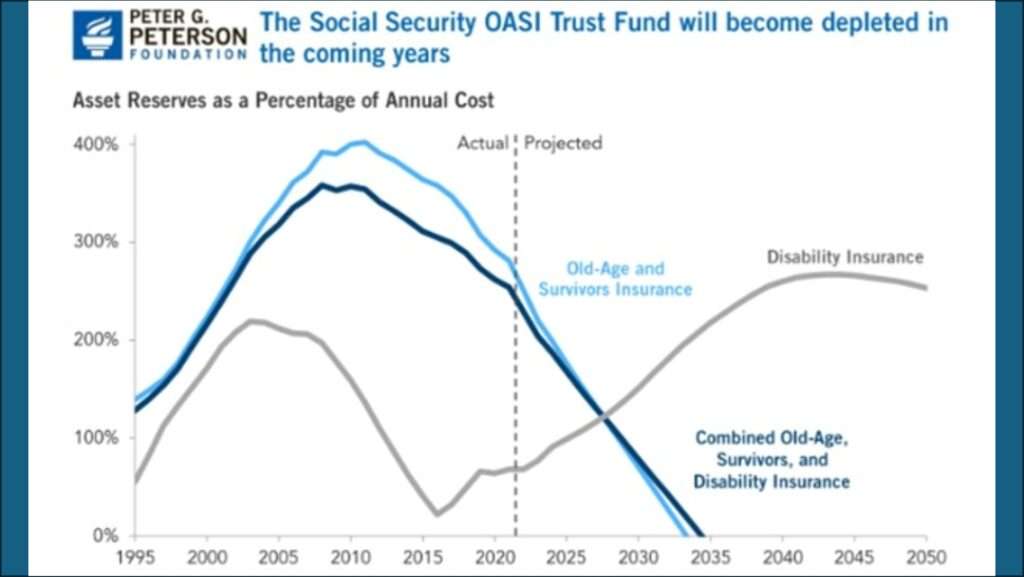
In 2033, according to the latest projections, Social Security's trust fund "will become depleted," and "continuing program income will be sufficient to pay 77 percent of scheduled benefits." Two years before then, Medicare's hospital insurance trust fund "will be sufficient to pay 89 percent of total scheduled benefits."

a graph showing Social Security's looming shortfall
(Peter G. Peterson Foundation)


The programs' trustees note that "lawmakers have many options for changes that would reduce or eliminate the long-term financing shortfalls." But Trump and Biden have ruled out nearly all of them because they don't know which promises to break.

It will be said that the problem with the entire system is that working people paying into the system are beginning to shrink and those taking out--retired and elderly--are growing. But the real problem is much more pointed: there is an unbridled eagerness for the government to follow what sounds like good ideas but are philosophically and/or economically self-destructive. The triumph of the immediate over the long term.

Last week, when the Republican Study Committee suggested gradually raising the minimum age for full Social Security benefits from 67 to 69, the White House immediately condemned that modest proposal. So the decision on managing this inevitable problem will be delayed... and put off... and tabled... until there is no choice but to act. 

Then those who created the problem will be seen as problem-solvers.