Saturday, January 18, 2020

Charts on Motherhood, CO2 and Texas Production


            Charts on Motherhood, CO2 and Texas Production


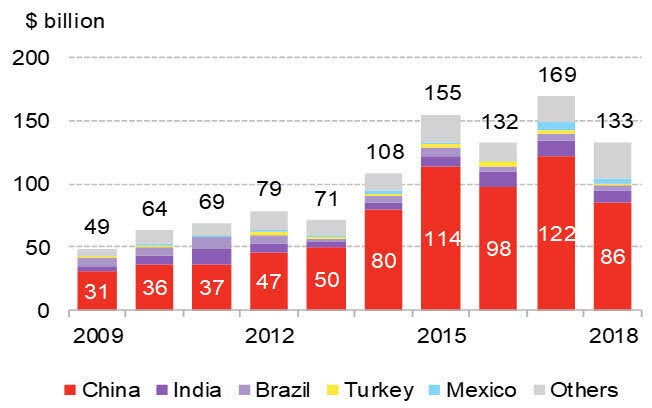
A Bloomberg New Energy Finance chart shows investments in new solar, wind and other non-hydroelectric power projects dropping

Between now and 2050, CO2 emissions are projected to decrease by 4% in the OECD countries and increase by 36% in the non-OECD countries. To combat rising CO2, perhaps Greta Thunberg is lecturing the wrong people


Friday, January 17, 2020

Learning Environments


                                      Learning Environments


From David Epstein:

"The wider world is mostly characterized by wicked learning environments, where you can’t see information. It’s hidden from us. Feedback is delayed and sometimes inaccurate.

One of the examples is a famous New York City physician who was renowned for his ability to predict that patients would get typhoid. He predicted the sickness time and again. He would palpate their tongue (feel around their tongue) and predict, weeks before patients had a single symptom, over and over, and became famous, and as one of his colleagues said, he was a more productive carrier of typhoid than even Typhoid Mary because he was giving his patients Typhoid with his hands. In that case, the feedback he was receiving was reinforcing exactly the wrong lesson.

So that’s the extreme of a wicked environment where your feedback teaches exactly the wrong lesson.”

Thursday, January 16, 2020

Process of Diversity


                            Process of Diversity

Does diversity have value in itself? Or, when we speak of diversity, do we assume a certain level of quality? We usually don't include stone-age cultures or cultures rich in human sacrifice when we consider diversity. What is it about diversity we like?

It certainly isn't difference alone. No one wants to spice the college scene with a few affable Nazis. Nor would we advocate diversity for entertainment value alone; there must be something else, something more.

I think most likely the possibility of "contribution," the bringing of a new, perhaps oblique view to the table where the condition of man is being discussed. It implies quality and interest in human advancement, not simple difference. It is a distinction in perspective. A unique vision of value. Diversity is part of the creative direction, not the outcome; it is the interface, not the result.

Here is Sowell on diversity, assuming some basic agreements:

“If there is any place in the Guinness Book of World Records for words repeated the most often, over the most years, without one speck of evidence, “diversity” should be a prime candidate. Is diversity our strength? Or anybody’s strength, anywhere in the world? Does Japan’s homogeneous population cause the Japanese to suffer? Have the Balkans been blessed by their heterogeneity — or does the very word “Balkanization” remind us of centuries of strife, bloodshed and unspeakable atrocities, extending into our own times? Has Europe become a safer place after importing vast numbers of people from the Middle East, with cultures hostile to the fundamental values of Western civilization?

“When in Rome do as the Romans do” was once a common saying. Today, after generations in the West have been indoctrinated with the rhetoric of multiculturalism, the borders of Western nations on both sides of the Atlantic have been thrown open to people who think it is their prerogative to come as refugees and tell the Romans what to do — and to assault those who don’t knuckle under to foreign religious standards.

It has not been our diversity, but our ability to overcome the problems inherent in diversity, and to act together as Americans, that has been our strength.”

Diversity is a part of a process, not the endpoint.

Wednesday, January 15, 2020

Conservativism, Tribalism and Contradiction


             Conservativism, Tribalism and Contradiction

Conservatism has a lot of analysis. What is its relationship with the economy? With its historical heroes? A couple of good comments on Conservatism from somewhere:

Conservatism, at its heart, is comfortable with contradiction, and in utopian thinking, all contradictions are supposed to be wrenched out of society. No two good things need to be in conflict with each other.

Anti-utopianism requires acknowledging that life can be unfair, that government can’t do everything, that the market will reward things we don’t like and erase things we love. Every government policy involves some trade-off between competing goods. Freedom will produce inequality not because freedom is unjust, but because freedom will yield different results since people are born with different abilities, have different desires, and make different choices. We will never live in a world where school teachers make as much money as professional basketball players. Of course, injustice exists, but the pace of reform must be guided by prudence and cost-benefit analysis. “I must bear with infirmities until they fester into crimes,” as Edmund Burke said.

The second reason is related to the first: Conservatism isn’t supposed to be a tribal identity. There is nothing inherently threatening to the idea of conservatism to say that some conservatives can be evil, stupid, or wrong about some things. Nor is it antithetical to conservatism to concede that some liberals are decent, smart, or right about some things. But tribalism requires drawing a stark line between Us and Them.

That’s what happens when you give in to tribalism: It starts to make sense. It even starts to feel natural—in part because it is natural. But part of what it means to be a conservative is understanding that not everything that is natural is good and not everything that is unpopular is wrong.

Tuesday, January 14, 2020

P3


                                                             P3

An article popped up on Microsoft News about the Peak Performance Project (P3) in Santa Barbara, California. They are investigating the science of movement. And they have started exactly where you would have guessed.

Dr. Marcus Elliott, a Harvard-trained physician and founder of P3, has seen the data and – he believes – the future.
“We understand these athletes and how they’re going to perform on an NBA court before they set foot on an NBA court,” Elliott says.
“All of these kids going through this NBA Draft – including Zion Williamson and R.J. Barrett from Duke (University) – have been coming to see us since they were 16, 17 years old. With our data, we can give them injury-risk models and performance models to help guide their career development,” Elliott says. “Nobody has this biomechanical information on them. We have years of it."

Launched in 2006, P3 is the first facility to apply a more data-driven approach to understanding how elite competitors move. It uses advanced sports-science strategies to assess and train athletes in ways that will revolutionize pro sports – and, eventually, the bodies and abilities of weekend warriors, Elliott says.
“We are challenging them and measuring them. But we’re not interested in how high they jump or how fast they accelerate,” Elliott says. “We’re interested in the mechanics of how they jump, how they accelerate and decelerate. It’s helping us unlock the secrets of human movement.”

Working directly with players and their agents or families, P3 has evaluated members of the past six NBA draft classes, amassing a database of more than 600 current and former NBA athletes.
P3 outfitted its lab with a high-speed camera system manufactured by Simi Reality Motion Systems GmbH, a German company from the ZF Group and a Microsoft partner.
Simi offers markerless, motion-capture software that removes the need for athletes to wear tracking sensors while they play or train. Simi also works with seven Major League Baseball clubs, deploying high-speed camera systems to those stadiums to record every pitch during every game since the 2017 season.

Simi’s software digitizes the pitchers’ arm angles and related body movements, spanning 42 different joint centers across 24,000 pitches thrown per team per season. That produces hundreds of billions of data points that are uploaded and processed on Microsoft Azure, enabling teams to create in-depth biomechanical analyses for the players, says Pascal Russ, Simi’s CEO.
“The first team that deploys this effectively on the field to pick lineups or to see which pitch angles worked well against which batters is going to see a huge separation between them and the other teams not using this,” Russ says.

“It’s freakishly accurate.”

While Russ foresees this technology eventually remaking baseball, such seismic shifts already are occurring in the NBA through P3’s player assessments, says Benedikt Jocham, Simi’s U.S. chief operations officer.
“We provide the software solution that can quantify the movement and analyze, for example, how much pressure and torque a person is putting on various body parts,” Jocham says. “P3 adds the magic sauce. They are wizards at figuring out what it all means and making sense out of it for athletes.”

After the cameras record a player’s movements in the P3 lab, those datasets are loaded into Azure where machine-learning algorithms reveal how that player’s physical systems are most related to other NBA players who were similarly assessed. The algorithm then assigns that player into one of several clusters or branches that predict how their basketball career may unfold, Elliott says.

One branch, for example, contains athletes who had a brief NBA experience and never became significant players. Another branch encompasses players who were impactful during their first three or four seasons then sustained serious injuries that depleted their skills. In still another branch, players share rare combinations of length, power and force that fed elite careers – and they remained healthy.


The data is also helping to shatter long-held theories that successful NBA players who, at first glance, lack the size, jumping ability or quickness of traditional stars are merely compensating by tapping unmeasurable intangibles such as “intuition” or “IQ” or “heart.”
“That’s how people once would have defined (2017-18 NBA most valuable player) James Harden, as somebody who just has this super-high basketball IQ,” Elliott says. “Maybe he does. But he also has a better stopping or braking system than anybody we’ve ever assessed in the NBA.

Case in point: Dallas Mavericks rookie Luka Doncic. In its pre-draft assessment of Doncic one year ago, P3 identified that same hidden performance metric – the elite ability to stop quickly. P3 knew, before his NBA Draft, that Doncic and Harden were in the same player branch. Doncic posted a stunning first pro season.

Every NBA player or draft prospect assessed by P3 receives a report that highlights their injury risks and compares them to league peers based on performance.

Eventually, this same information may become available to amateur athletes and everyone else, Elliott says. The same technologies could predict, for example, that a weekend warrior has too much force going through the left leg while jumping or landing plus a tiny but unhealthy rotation of the left knee and femur, causing too much friction, and, eventually, an erosion of the left knee cartilage.

“What if you identified that when you were 30 or 20, instead of learning when you’re 50 that your cartilage is gone? That really is the future,” Elliott says.


I'll be surprised if we don't see this used by teams like the Pirates, who are always substituting technology and schemes for talent. 

Monday, January 13, 2020

Do We Need Press Briefings?


                 Do We Need Press Briefings?

Seven former White House press secretaries joined six former State and Defense briefers for an open-letter CNN opinion piece arguing for a return to regular press briefings.

The Trump White House has not held a traditional press briefing since March 11, when Sarah Sanders was still the press secretary.


They argue:
"The process of preparing for regular briefings makes the government run better. The sharing of information, known as official guidance, among government officials and agencies helps ensure that an administration speaks with one voice, telling one story, however compelling it might be.
Regular briefings also force a certain discipline on government decision making. Knowing there are briefings scheduled is a powerful incentive for administration officials to complete a policy process on time. Put another way, no presidents want their briefers to say, day after day, we haven't figured that one out yet. ...
Using the powerful podiums of the State Department, Pentagon and White House is a powerful tool for keeping our allies informed and letting our enemies know we are united in our determination to defeat them both on the battlefield and in the world of public diplomacy."

Asked for a response, White House press secretary Stephanie Grisham told Axios:
"This is groupthink at its finest. The press has unprecedented access to President Trump, yet they continue to complain because they can’t grandstand on TV. They’re not looking for information, they’re looking for a moment. This president is unorthodox in everything he’s done. He’s rewritten the rules of politics. His press secretary and everyone else in the administration is reflective of that.
In terms of the former press secretaries — they can publicly pile on all they want. It’s unfortunate, because I’ve always felt I was in this small club of only 29 others who really know what I deal with each day, and that was always comforting. They may not say it publicly, but they all understand why I do things differently. They know I have three roles. They know my boss has probably spoken directly to the press more than all of theirs did combined. They know the press secretary briefs in the absence of the president, and this president is never absent — a fact that should be celebrated.
Like so many trailblazers, history will look back on this presidency with praise — until then, I’m comfortable with how I do my jobs — and my team and I are always available to the press."

Sunday, January 12, 2020

How can you say to me, I am a king?


            How can you say to me, I am a king?


Harry and Meghan are having a wonderfully human experience as they debate their future.

Immersing the Royals in the world has some dangerous implications. And there are some distressing practical elements too. Coding logs on the Sussex Royal website show that work on their new online presence began in September.

In December, Harry and Meghan trademarked the “Sussex Royal” brand, including 100 items ranging from notepads and socks to counseling services. The Sussexes will most likely be a “luxury brand”, on the levels of Louis Vuitton and Burberry, but they will have to carefully balance their personal lives from a PR respective to maintain that. Andy Barr, retail expert at price tracker website Alertr.co.uk, told Sky News the Sussexes have the potential to “dwarf” the earnings of Prince Charles, whose Duchy brand makes an estimated £100m to £200m a year.

A possible early indicator, the Duchess of Sussex has reportedly signed a voiceover deal with Disney in exchange for a donation to a wildlife charity, according to multiple reports.

Ah, commerce. Maybe it's the Yankee in her. I foresee a partnership--economic and perhaps political-- with Oprah (and maybe the Clooneys.)

Well, let's go back to the more elevated concerns of man."The Crown" has a great moment where the mediocre Charles, fresh from his eye-opening experience in Wales preparing for his investiture as Prince of Wales, returns to Cambridge where he plays Richard the Second in the school play. These are the lines he recites, as King Richard cedes political control of England to the rebellious Henry Bolingbroke:


1 Let's talk of graves, of worms, and epitaphs.

2 Make dust our paper and with rainy eyes

3 Write sorrow on the bosom of the earth.

4 Let's choose executors and talk of wills.

5 And yet not so, for what can we bequeath

6 Save our deposed bodies to the ground?

7 Our lands, our lives, and all are Bolingbroke's,

8 And nothing can we call our own but Death

9 And that small model of the barren earth

10 Which serves as paste to cover our bones.

11 For heaven's sake, let us sit upon the ground

12 And tell sad stories of the death of kings,

13 How some have been deposed, some slain in war,

14 Some haunted by the ghosts they have deposed,

15 Some poisoned by their wives, some sleeping killed,

16 All murdered. For within the hollow crown

17 That rounds the mortal temples of a king

18 Keeps Death his court, and there the antic sits,

19 Scoffing his state and grinning at his pomp,

20 Allowing him a breath, a little scene

21 To monarchize, be feared, and kill with looks,

22 Infusing him with self and vain conceit,

23 As if this flesh which walls about our life

24 Were brass impregnable. And humored thus,

25 Comes at the last, and with a little pin

26 Bores through his castle walls, and farewell king.

27 Cover your heads, and mock not flesh and blood

28 With solemn reverence. Throw away respect,

29 Tradition, form, and ceremonious duty,

30  For you have mistook me all this while:

31 I live with bread like you, feel want,

32 Taste grief, need friends. Subjected thus,

33 How can you say to me, I am a king?